




Reading Predrag Matvejević’s book in Mostar A.D.2026
TALK ABOUT MEDITERRANEANS can be serious or ironic: how they became city dwellers, fishermen, and navigators or how they remained peasants, shepherds, and landlubbers. Mediterraneans feel closer to their cities than to their states or nations; indeed, cities are their states and nations and more.”
(All the quotations in this article come from the book Mediteranski brevijar by Predrag Matvejević [Zagreb, Grafički zavod Hrvatske, 1987], translated into English by Michael Henry Heim as Mediterranean: A Cultural Landscape and published by University of California Press in 1999.)[DRS1]
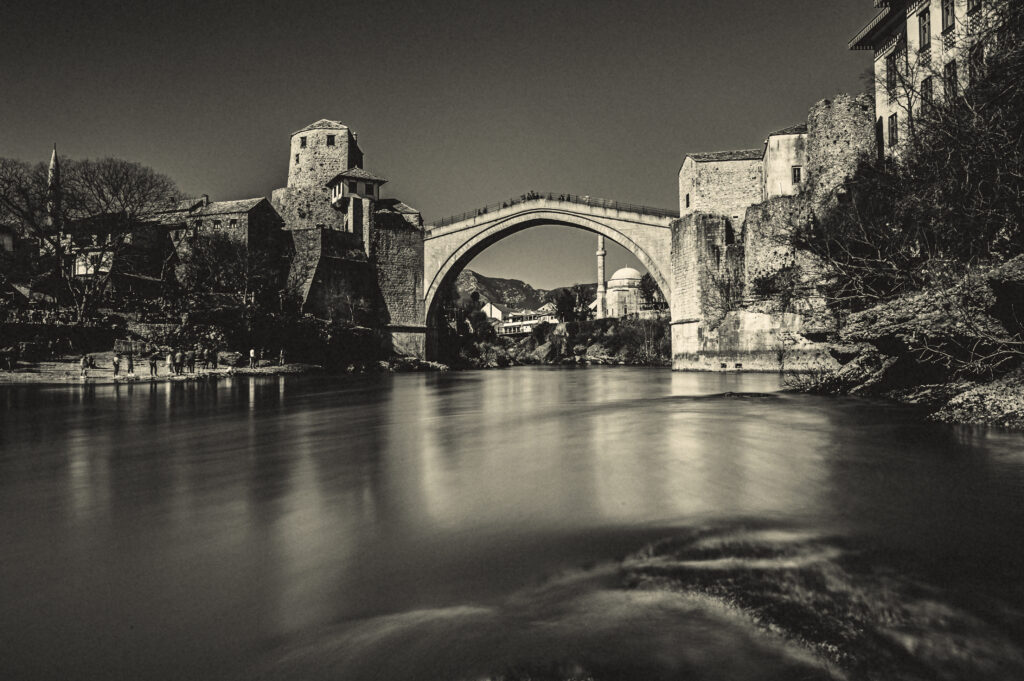
As a citizen of Matvejević’s birthplace, Mostar, the city that has died and resurrected in recent history, I recognize his longing for the Mediterranean as my own. I have felt the same scent of the sea on bright mornings by the Neretva River. I have laughed at the tourists for not being aware that you simply do not walk around at noon along the streets of Mostar, because the sun is too bright and the air is too hot. I have eaten the figs and the pomegranates that belonged to nobody, that belonged to the stone gardens of this city, that belonged to the sun and to us. I know that my (our?) sense of humor is sometimes too brutal in Sarajevo, about 100 kilometers to the north. At the same time, I am aware that calling myself a real Mediterranean is not really entitled, because – Matvejević writes beautiful pages about it – it is the sea that primarily defines the Mediterraneans, and Mostar is not situated by the seaside. Nevertheless, I am reading his book not only as a map and encyclopedia of the sea and great civilization, but as a record of a desire for it, and still enjoying its hybrid and peripheral spaces.
I am reading his book not only as a map and encyclopedia
of the sea and great civilization, but as a record of a desire
for it, and still enjoying its hybrid and peripheral spaces
No one writes about the Mediterranean or sails it without personal involvement. The city where I was born is located fifty kilometers from the Adriatic. Thanks to its location and the river that runs through it, it has taken on certain Mediterranean traits. Slightly farther upstream, the Mediterranean traits disperse and the mainland takes over the connections between them.
I allow myself to write down some associations to the passages of Matvejević’s famous text. It will be some ideas appearing to a theatre artist in Mostar, the author’s birthplace, in the XXI century, a few decades after the horrible war. Maybe I am just trying to answer a simple question myself: does my city still exist as it was before all the evil and destruction?
Moreover, cypresses and pines are often planted near places of worship and graveyards either one by one, in isolation, or (…), in groups. None of this would seem to be arbitrary, though patterns are difficult to establish. Cypresses bring peace and a certain melancholy to their environment, for example, though they are planted in places other than graveyards and churches: they also rise up over the Mediterranean’s schools and sacrificial altars.
Cypresses and pines are very important for the picture of Mostar before the war. There was a road to the south flanked by cypresses and pines on both sides; I still remember it, resembling a Roman road in a green valley. There are no cypresses any more. In their place there are houses, gas stations and bakeries. The municipal hospital was built in Mostar in 1882. At the same time two cedars were planted in front of it, which grew and lived until the hospital was demolished. Some citizens were trying to protect huge, beautiful one-hundred-year-old trees. In vain. They were nothing for the new inhabitants of the city, who were building the contemporary temple, a big shopping mall. There were other, more modest trees, but still important for Mostar, which paid the price of the new consumption temple: a row of hackberries (European nettle tree, celtis australis) down the whole street. Children loved their wild fruits: they were like strange sweets in each little brown berry. But they were perhaps even more popular as ammunition for a slingshot, at a time when wars were only played out by children on the streets of Mostar.
Nearly every Mediterranean city has at least one such archive, public or private, open or secret, just as each has at least one cemetery. The Mediterranean is a vast archive, an imminence grave.
Maybe I am just trying to answer
a simple question myself – does
my city still exist in the shape
before all the evil and destruction
Memory and past are the equal part of the present day. Cities full of history and shadows of the ancestors keep their archives in every stone; one of the most distinctive characteristics of a full citizen (of Mostar, for example) is to remember people, families, ancestors, streets, houses, parks and significant trees. But what happens when a modern catastrophe tries to turn the city into dust? Memory and the past are the first victims. Citizens were exchanged for inhabitants; many citizens perished, left the city (there are probably other Mostars in diaspora, all over the world), many people from smaller towns and villages came to the city, some of them in the frame of ethnic cleansing, to feel as new rulers and aristocrats, some of them escaping from elsewhere, fighting for life itself. Most secret archives were lost. There is an urge to write history from zero, and the names of many streets in the city were changed. Instead of perished partisans, communists, poets and doctors there are the names of some old and mythical kings and queens. Old citizens cannot remember all those kings, or they do not want to. They are stubborn in calling the streets by their old names, as if remembering them was an important ritual against Loss and Oblivion. As for the cemeteries, there is still one in the middle of the city, in the park. During the war people were not able to bury their loved ones in the cemeteries located in the suburbs for fear of bombs, so the little park became the saddest memento of death and fear.
Mediterraneans are not known for their gratitude (though when they do thank, they make many promises and believe in them). (…)
There is not much gratitude in the people of Mostar. Especially now, in this fog of oblivion, they rarely remember with gratitude important people from the past of the city.
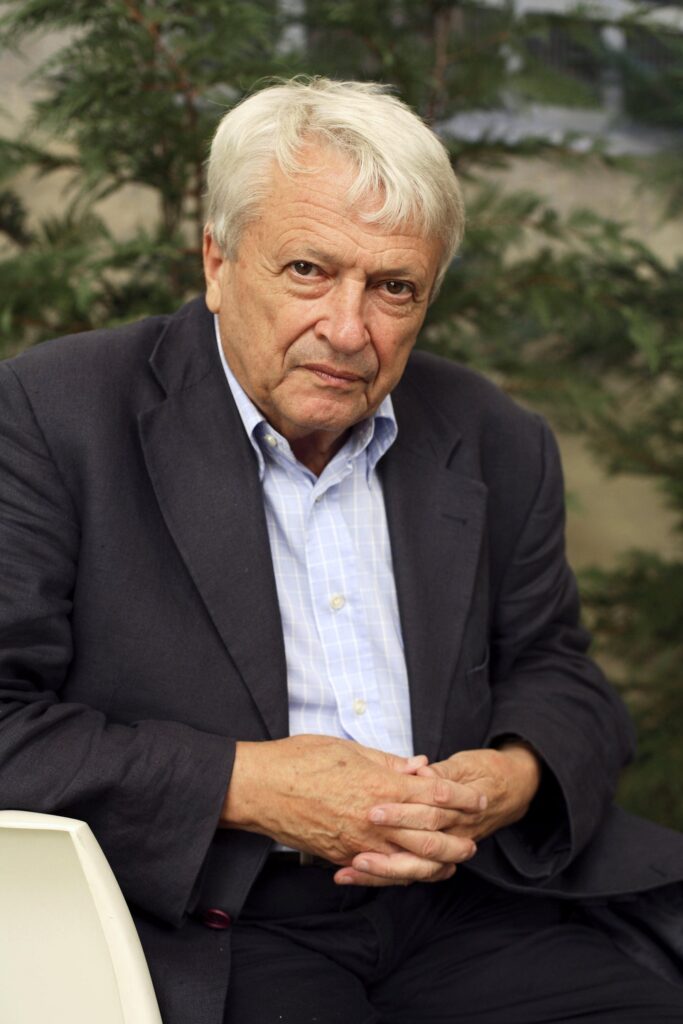
The first painful example is the author of the book that I am contemplating, Predrag Matvejević. He was born in the center of Mostar, and maybe it is symbolic that his birth house was on the very frontline during the last war, just between the Croat and Bosnian Army fighting. Afterwards, that line formed an unofficial “two cities”, two ethnically defined monsters. Matvejević’s house was standing proudly as a bridge, as a lighthouse. There was an initiative started by artists in Mostar that the city council should buy the (then completely destroyed) house and set up a cultural institution there dedicated to the intellectual heritage of Matvejević. But this did not happen, and in the place of his birth house there is now a hotel. Perhaps even more tragically, the writings and ideas of this great author, anti-nationalist and freedom fighter, are not familiar to the average citizens of Mostar, and they are not present in public reflection and discussion. His wonderful spirit of polemics, which could be revisited in democratic dialogue, is not present in his birthplace. Instead of arguments and dialogue, there are parallel monologues.
Another great man that receives very little gratitude (from small groups of artists and activists aware of the monumentality of his work) is Bogdan Bogdanović, an architect who built the wonderful Partisan Memorial Cemetery. This original pearl of architecture and landscape design creates a necropolis resembling the spirit of Mostar: stone walls, terraces, paved paths, many authentic trees – including pines and cypresses, water – a river running in a canyon, a lake… The memorial cemetery was not only a place to pay respect to the perished partisans, but it was a wonderful architectural park for the living. The stones were shaped by traditional stonemasons, in a process similar to the building of the iconic Old Bridge in 1566. As Matvejević writes:Many other crafts, though disappearing, are still alive in the Mediterranean memory: stonecutting and stonecarving (without which there would be no great structures) (…)
Bogdanović was not only an architect but also a philosopher, so all of his works had a deep philosophical grounding. Nowadays, Partisan Memorial Cemetery is in ruins and permanently attacked and vandalized by neo-Nazi hooligans. The political paradigm of the ruling parties is revisionism, all too often sympathizing with the enemies of the partisans in WW2. Even the argument that such a brilliant monument would attract many tourists (in the city that lives mostly from tourism) is not important enough for them.
I do not know to what extent languages east of ours have borrowed terms from our languages (…); I do know that many-with much the same Mediterranean flavor as the words just enumerated – have reached my language from Turkish and, to a lesser extent, Arabic: words like avlija (courtyard), cesma and sadrvan (fountain), sokak (a narrow street), mehana (tavern) and mahala (district), sefa and divan (couch), eglen (chat) and eglen-beglen (chitchat), dzezva (uncovered metal receptacle with a long handle formaking Turkish coffee) and sofra (round table at which one eats while sitting on mats), istilah (lethargy) and rahatluk (satisfaction), merak (pleasure) and merhamet (pity), sevdah (amorous passion), and teferic (outing).
(…) It is the most open space on the Mediterranean and the path along which the prophecies made their way to us, the place where the sun first rises and darkness first falls.
Mostar has its own, specific dialect that was created through centuries of occupation (Ottoman Empire, Austro-Hungarian Empire). Many local words are Turkish, which is no wonder after 500 years under the Ottoman occupation, such as those mentioned by Matvejević. Turkish words are present in the language of the whole of Bosnia and Herzegovina. But for some reason there are many words that remained only in Mostar, and they are localisms unrecognized in the rest of the country: majdonos (parsley), saransak (garlic),as well as many words for human characteristics or profiles. There are also some archaic local words that came from some other languages: prtokalo (orange,from the Greek portokalo), kifeli (go away, from Hungarian).Language is alive, it is an organic structure that naturally changes through time. But local language in Mostar was always a sign of the cultural variety of its history and its present. Moreover, there is a specific melody in local speech, which is kept as a sign of Mostarian identity.
In the period after the last war, the language became another victim of political battles. Officially, citizens of Mostar (according to their ethnic background) speak two different languages: Croatian and Bosnian. Although it is linguistically very doubtful if there are actually two distinct languages, the young people of Mostar have been participating in two parallel systems of education – Croatian and Bosnian – for thirty years. Absurdly, the language, which is a river and a bridge, something that aims to connect people, in this case became a wall.
Are people who believe in God and pray to Him more divided by their various faiths and prayers than people who do not believe or pray?
This question, put by Matvejević in eternal philosophical discourse, was unfortunately answered very directly and brutally realistically in the latest war in Bosnia and Herzegovina.[1] Faiths were too often misused to divide people of different ethnic backgrounds, who had been creating a diverse society for centuries; there was massive identification between faiths and nations, and religious communities supported nationalism even when it meant war crimes. All faiths are still under strong influence of nationalistic politics and often propagate nationalist politicians and policies from their religious discourse. In my humble opinion, too many religious leaders in Bosnia and Herzegovina during the war compromised their faiths and exchanged sacred humanism for materialistic and power-driven practice.
There are too many examples. There is a place called Međugorje near Mostar, where allegedly the Virgin Mary appeared and it is a site of pilgrimages from around the world. She is often called the Queen of Peace there. But during the war she did not protect thousands of people who were being killed and kept in concentration camps in nearby Mostar, and her holy place was not a safe haven for them. They were victims of the “wrong” religion and the perpetuators were coming “from her side”.
The locations of Mediterranean marketplaces are commensurate with those of major institutions such as the town hall and the fortress, the place of worship and the place of eternal rest. Politics and trade meet in the marketplace, meet as friends and as enemies. Thus it was in the Greek agora; thus it was in the Roman forum.
As if it was a real Mediterranean city, Mostar lives outside, under the skies, on the streets and under the trees for much of the year. Children still play in yards. Young people still sit in parks and on the small walls in the evening, not everybody is in clubs and bars. Sometimes even elderly neighbors sit and have coffee in small gardens in front of their blocks, where old ladies grow flowers under their windows. But it is difficult to say if there is still a real agora there.
Reconstruction of the destroyed city after the war changed its geography and urban structure. Some places that used to be squares and places where many people gathered were adapted to mostly serve cars, with streets and parking. Mostar was proud to have the first roundabout in the 21st century, modeled on Paris and therefore called Rondo. It is surrounded by streets with old alleys of plane trees and neighboring the big park and the pedestrian promenade. All that part of the city is full of beautiful Austro-Hungarian villas. There used to be a café with a huge garden, which acted like an agora before the war. An open space and a square served the typical Balkan habit of spending time in bars and cafés. After the war, the space was reconstructed, a café disappeared, the whole space is a wide street now, and instead of a simple meeting point there is a war monument. Another public space dating back to the Ottoman period was Musala Square, surrounded by a beautiful park, an Austrian hotel built in the characteristic pseudo-Moorish style – a variant of Art Nouveau with Oriental motifs developed by the Austro-Hungarians specifically for Bosnia and Herzegovina –, a public bath in the same architectural style, and later, a music school. The whole space is now practically transformed into a street and parking, a wonderful park disappeared, and only the hotel is being reconstructed in its original form. In the absence of a square, a new one was built (a Spanish square), but it has become a place of political protests and demonstrations and never fulfilled its purpose of a place for meeting and dialogue. Lacking a natural setting for dialogue, exchange and discussion, Mostar closes itself into small groups leading monologues.
Speaking of one’s own people is no easy task: (…) the world knows little about the Mediterranean’s South Slavs – even their neighbors on the Adriatic – and because we ourselves have done little to remedy the situation. We have reiterated ad nauseum the extent to which the Mediterranean has marked the land we inhabit. It is a crossroads between East and West: the meeting place of Latin and Byzantine culture (…), the boundary between the Holy Roman and Ottoman Empires and a battlefield for Christianity and Islam. Our culture has developed in a symbiosis with Mediterranean cultures as a “third component” among such oppositions as east/west, north/south, land/sea, Balkan/European, and others more homegrown. (…) Like everyone, we ask ourselves what we are, individually and as a whole.
Many of us (in Mostar) still find our identity in this space of the “third component”, identity marked mostly by cultural and religious diversity. There is a specific concept in our society that is called komšiluk (neighborhood), which literally means to live in houses nearby, but in our society it denotes the specific ethics of living in a multicultural neighborhood. Respect and knowledge for other religions are the foundation of that ethics. We have all grown up knowing all the traditional greetings for the holidays of all religions living around us (although, for instance, my parents’ generation was mostly communist and atheist). Neighbors with other religions were always special guests on holidays and respect was always shown by strictly respecting the dietary restrictions of others (the most important of them being the fact that Muslims do not eat pork). But the ethics of common life in the neighborhood was much wider than religious diversity; it meant friendships, spending a lot of time together, in a way it is a kind of extended family.
Although I strongly believe that this specific culture and ethics still live among many citizens of Mostar, mainstream politics is focused on separating ethnic and religious groups. It insists on “vital national interests”, closing these groups in circles of their own exclusive religion and culture, and defining their languages as different. So, the question as to who we are seems to be answered very clearly nowadays. The problem for me and people like me is that such an answer goes against everything we feel about our local identity.
Finally, Matvejević again sees it from macro historical perspective and let us be comforted with his idea that certain times will come when really being together in diversity will become the new political and social mainstream.
The multiplicity of peoples in Illyria will make for major problems when the time for nation-building comes to the Balkans. (…) Balkan people, like many other Mediterranean peoples, have opposed one another at certain times and come together at others; differences between them may disappear or increase. Some treat the phenomenon with alarm, others with irony; writers treat it in odes or parodies.
We need a vision for the future, the vision
that will use all good practices from the past,
but will be created in the realms of modernity
and future, within the world in ecologic crisis and digital shift
Matvejević sees the history of the Balkan people in terms of the dialectical agon. But we, the subjects and the objects of that agon, feel in our own lifetime the tragedy of the moments when differences increase. Moreover, at present we feel an awful burden of political insistence on increasing differences. How can we overcome it? Certainly, good memories and nostalgy do not help, even if they make life a bit easier. We need a vision for the future, a vision that will use all good practices from the past, but created in the realms of modernity and future, within the world in ecologic crisis and digital shift. We need a masterpiece of shipbuilding to navigate us through the Mediterranean Scylla and Charybdis of our future.
Mostar, April 2026.
[1] When Bosnia and Herzegovina’s independence was recognized by the United States and the EC on April 7, Bosnian Serb paramilitary forces immediately began firing on Sarajevo, and the artillery bombardment of the city by Bosnian Serb units of the Yugoslav Army began soon thereafter. In April, many of the towns in eastern Bosnia and Herzegovina with large Bosniak populations, such as Zvornik, Foča, and Višegrad, were attacked by a combination of paramilitary forces and Yugoslav Army units. Most of the local Bosniak population was expelled from these areas, the first victims in the country of a process described as ethnic cleansing. Although Bosniaks were the primary victims and Serbs the primary perpetrators, Croats were also among the victims and perpetrators. Within six weeks, a coordinated offensive by the Yugoslav Army, paramilitary groups, and local Bosnian Serb forces brought roughly two-thirds of Bosnian territory under Serb control. In May, the Army units and equipment in Bosnia and Herzegovina were placed under the command of a Bosnian Serb general, Ratko Mladić. From the summer of 1992, the military situation remained fairly static. A hastily assembled Bosnian government Army, together with some better-prepared Bosnian Croat forces, held the frontlines for the rest of that year, though its power was gradually eroded in parts of eastern Bosnia and Herzegovina. The Bosnian government was weakened militarily by an international arms embargo and by a conflict in 1993-94 with Croat forces. But later in 1994, Bosnian Croats and Bosniaks agreed to form a joint federation. The United Nations (UN) refused to intervene in the Bosnian War, but UN Protection Force (UNPROFOR) troops did facilitate the delivery of humanitarian aid. The organization later extended its role to the protection of a number of UN-declared “safe areas”. However, the UN failed to protect the safe area of Srebrenica in July 1995, when Bosnian Serb forces perpetrated the massacre of more than 7,000 Bosniak men (see Srebrenica massacre). – https://www.britannica.com/event/Bosnian-War 03.06.2026.
After taking control of western Mostar, a town in southern BiH, and systematically expelling Muslims from their homes, the HVO kept the eastern part of the town under siege from June 1993 to April 1994. The town was physically divided, and the eastern part of Mostar suffered heavy shelling and sniper fire. Ten mosques were significantly damaged or destroyed. A large number of Muslim civilians were injured or killed. The HVO often disabled the flow of humanitarian aid, which resulted in extremely difficult conditions for the Muslim population, who were often without food, water or electricity. During the conflict, the HVO arrested Muslim men of military age and kept them detained at several locations, including Dretelj, Heliodrom and Gabela, in territories controlled by the Croat forces in 1993 and 1994. In these camps, many of the detained men were subjected to severe mistreatment and/or killings. Muslim women, children and the elderly were also subjected to mass arrests and mistreatment, and were forcibly displaced to territories controlled by the BiH Army. – https://www.irmct.org/specials/war-bosnia/ 03.06.2026.