



Crossed perspectives on territory, social rights and culture by Amina Mourid, Claire Trichot and Zoubeir Ben Bouchta, exploring the unseen side of the Moroccan city
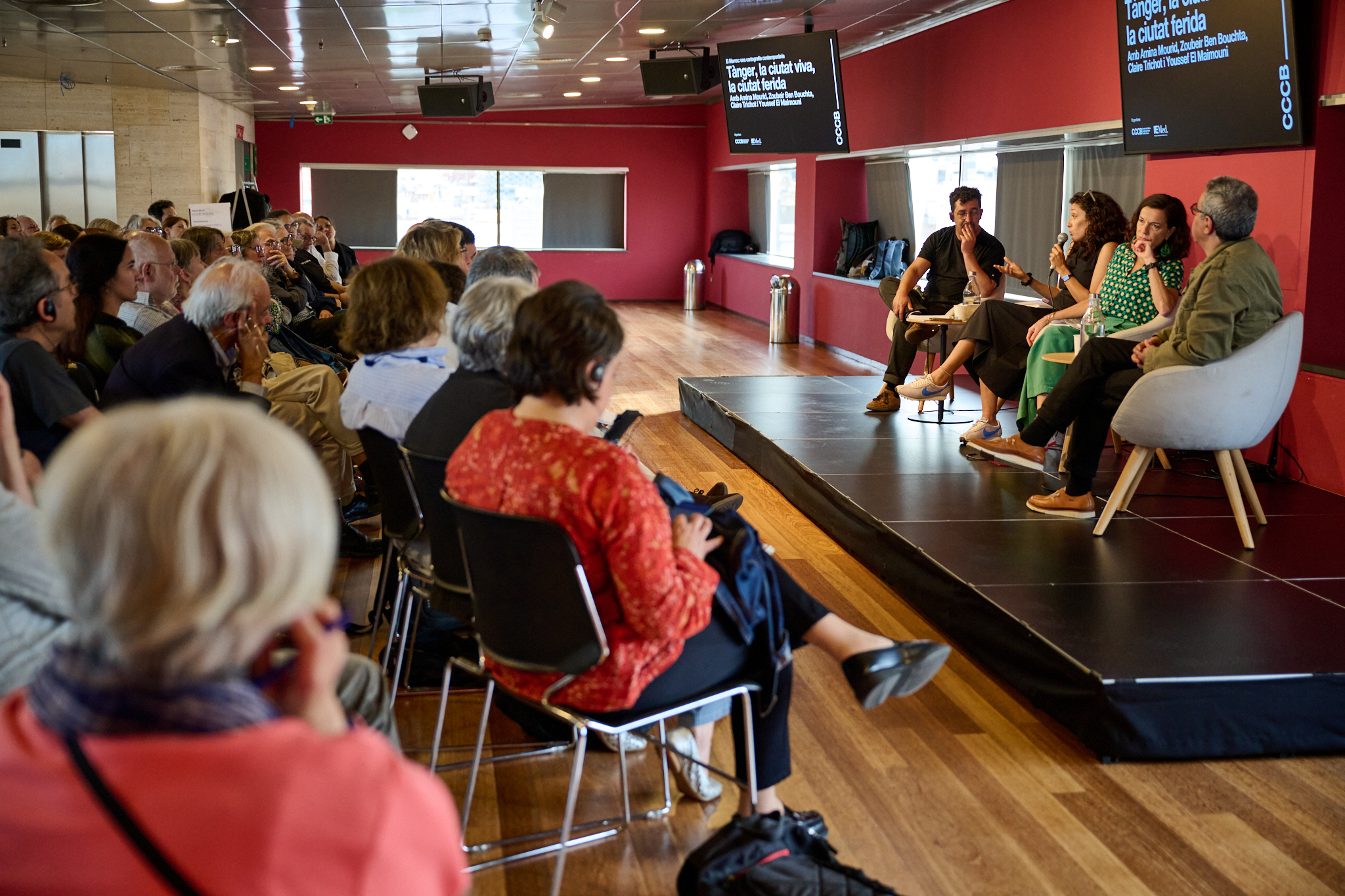
Three activists. Three voices deeply connected to Tangier’s cultural and social realities. They are cultural entrepreneur and urban planner Amina Mourid, co-founder of the cultural project Think Tanger; playwright Zoubeir Ben Bouchta, theatre director and founder of Riad Sultan Theatre; and activist Claire Trichot, president of the association 100% Mamans. Together, they were the protagonists of the roundtable Tangier, a Vibrant City, a Wounded City, organised by the Centre for Contemporary Culture of Barcelona (CCCB) in collaboration with the European Institute of the Mediterranean (IEMed).
As part of a broader programme under the project Morocco: A Contemporary Map, Mourid, Trichot and Ben Bouchta shared their perspectives on the transformations of their city, shaped by the myth of international Tangier and by significant urban and social fractures. This was the first stop in a series that, over the coming months, will visit three other Moroccan cities and territories to rethink contemporary Morocco through reflection on the historical, cultural and human ties linking both shores of the Mediterranean.
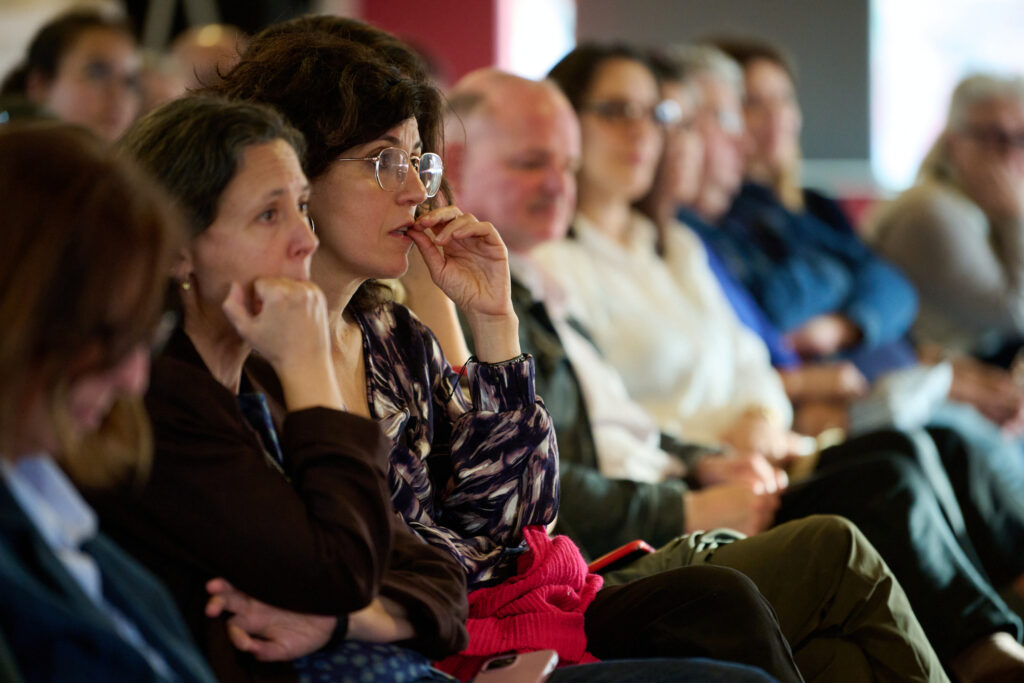
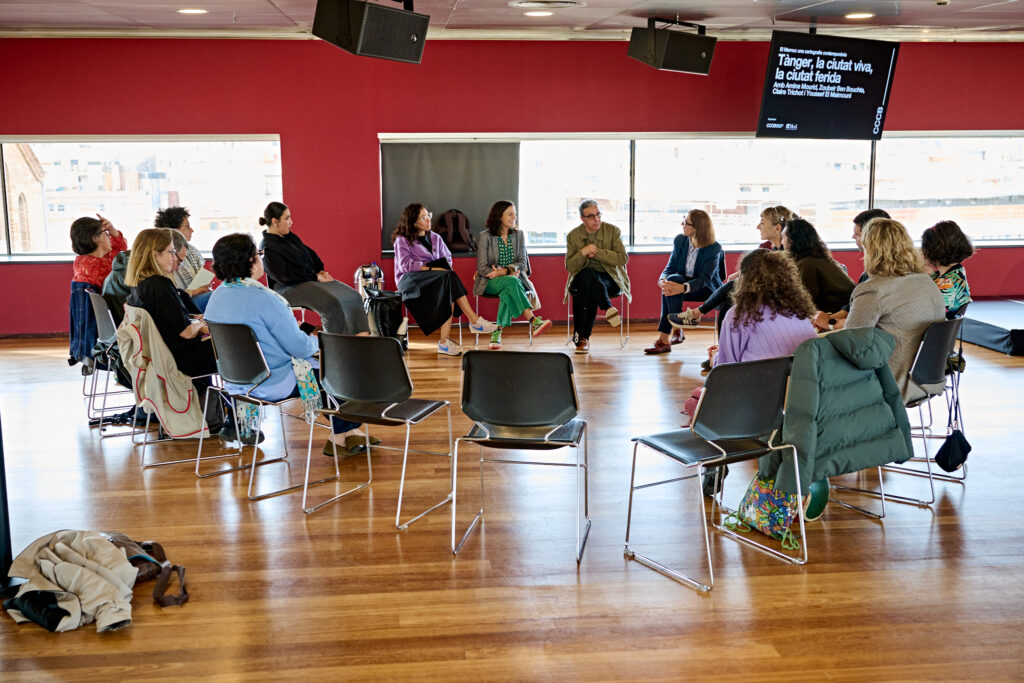
Before the public debate, moderated by writer Youssef El Maimouni, the three activists had the opportunity to exchange views with representatives of Catalan civil society, including Francesco Campolo from R-Evolución; Najat Bensar from the Ibn Rochd Association; Dolors Camats from the Catalunya-Europa Foundation; Laia Gómez from Mirada Rumiant; Enric Canet from Casal dels Infants del Raval; and Laila Khalil from the Ibn Battuta Foundation. This horizontal, closed-door gathering became a valuable opportunity to build bridges between organisations and share experiences as well as common challenges.
Once the microphones were on and the CCCB’s Mirador Hall was filled to capacity, El Maimouni opened the discussion with a quote from historian and urbanist Mohammed Métalsi: “Many have written about the city of Tangier, but few have devoted themselves to studying its history and improving the lives of its inhabitants.”
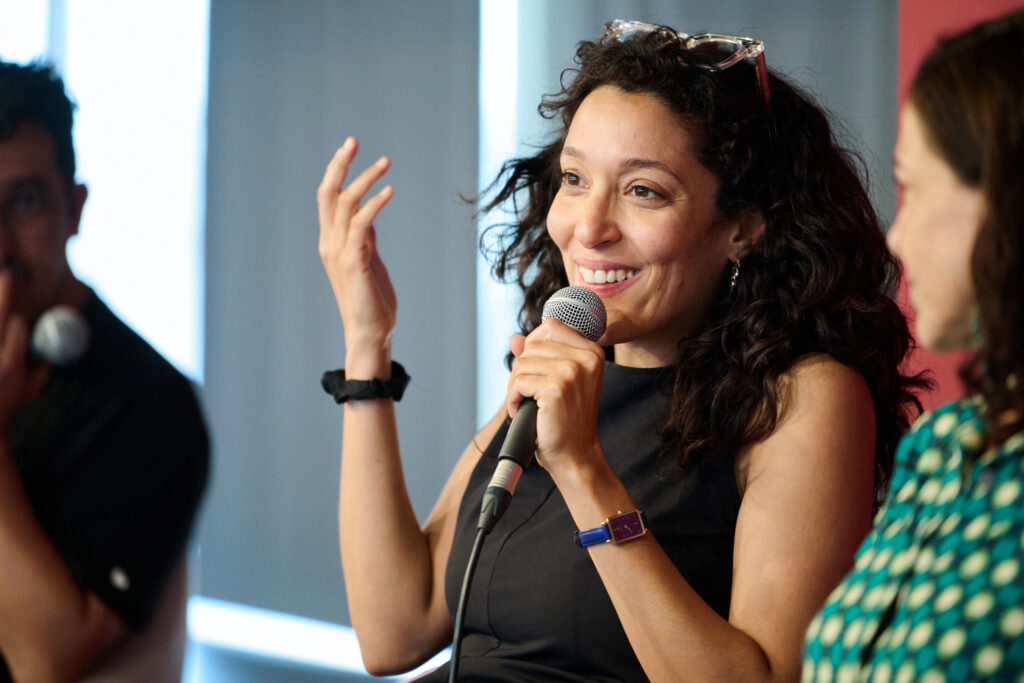
Referring to the title of the event, participants agreed that Tangier is undoubtedly a vibrant city, but differed on whether it is a wounded one. For Amina Mourid, it is rather “a fragile city undergoing exceptional transformations”, whose rapid growth makes it difficult to maintain balance in the face of contemporary challenges. For Claire Trichot, it is “a fractured yet transgressive city”, threatened by the risk of leaving its most vulnerable inhabitants behind. Zoubeir Ben Bouchta, meanwhile, accepts the idea of Tangier as a wounded city, but insists that it is “not a defeated city”, highlighting its ability to rise again and again from its ashes, “like a phoenix”.
The Tangier depicted on postcards is an exoticised and cosmopolitan city, shaped to some extent by the European imagination. Romanticised images show the white alleys of the medina descending towards the port and the bay, cafés and hotels from the international era where travellers, diplomats and artists once crossed paths, and bustling markets filled with vendors. Orientalist portraits, camels, terraces overlooking the Strait of Gibraltar and colonial architecture abound.
From Barcelona, from a privileged vantage point, we had the chance to glimpse other Tangiers. The ones never found in souvenir shops near the Kasbah. The ones absent from maps and postcards. What follows is a selection of the finest blurred snapshots of a city in the midst of transformation.
POSTCARD 1: THE INTERNATIONAL ZONE
In 1923, a special political and administrative regime was established in the Moroccan city: the International Zone of Tangier (1923–1956). Governed jointly by several European powers, including France, Spain and the United Kingdom, the territory was designed to secure strategic control of the Strait of Gibraltar and maintain a balance of power in the region. This shared administration turned Tangier into a singular enclave marked by freedom, permissive laws and favourable taxation, attracting criminals, spies, writers and all kinds of adventurers.
“Tangier’s geographical position has shaped its destiny,” notes Ben Bouchta. It is a city that cannot be understood without its past. “After the international period, it became national,” he continues, while Mourid adds that it was “marginalised in northern Morocco for political reasons until the late 1990s”. The years of excess and the refuge offered to the Beat Generation were left behind, yet a reality that had already begun to emerge during that period endured: the proliferation of concentric circles of precarity surrounding the privileges enjoyed by a small elite.
POSTCARD 2: THE MEDITERRANEAN PORT
With the dawn of the new century, the story changed. Tangier became one of the flagship projects of the Moroccan monarchy, which sought to transform it into a major economic hub through the creation of Tanger Med, now the largest logistics and port complex in Africa and one of the most important in the Mediterranean. The opening of the port triggered unprecedented industrial development and the construction of large-scale infrastructure. The city’s physical landscape was transformed forever.
Over recent decades, Tangier’s economic success and large-scale development have been undeniable. The city’s territory has expanded fivefold and its population has tripled. Yet such rapid growth, largely oriented towards international markets, has often resulted in a disconnect from local social realities. “A quarter of a century later, we still do not know what political direction we want to take,” explains Mourid. “Fortunately, we still have time to leave our mark on the territory, make use of the spaces that are opening up for reflection, and collectively decide what future we want for the city of Tangier.”
— Amina Mourid
“We still have time to leave our mark
on the territory and collectively decide
what future we want for the city of Tangier”
POSTCARD 3: THE LABYRINTH OF CONTRADICTIONS
Although Tangier may today appear to be a hive of opportunity attracting people from across the country, transnational migration remains the preferred option for many young people. It is a story inseparable from the history of countless Moroccan families. Despite major economic progress and the expansion of social rights, some things remain unchanged. Every year, around 300,000 children drop out of school. Being a single mother is still punishable by law. “In Morocco, there are still laws that do not correspond to people’s social realities and individual freedoms,” explains Claire Trichot, a human rights lawyer. “The contradictions are enormous and leave many young people trapped between frustration and the desire to be free and pursue their dreams beyond the country’s borders,” she adds.
Contradictions are also a tangible and everyday reality in the cultural sphere, according to poet and playwright Zoubeir Ben Bouchta. Despite a certain “cultural effervescence” in Tangier, it remains “poorly organised and takes place without meaningful support from the city’s institutions and cultural infrastructure”. “In Tangier, there is no real audience that regularly consumes culture as there is in Casablanca or Rabat,” explains the founder of the Riad Sultan Theatre. Through his work, he has sought to open a door to hope: “I envisioned this theatre as a Mediterranean space where audiences can appreciate culture and enjoy encounters and conviviality with artists.”
— Zoubeir Ben Bouchta
“I envisioned this theatre as a Mediterranean
space where audiences can appreciate culture
and enjoy encounters and conviviality with artists”
POSTCARD 4: THE CITY THAT DOES NOT APPEAR ON MAPS
From an urban perspective, Tangier faces challenges that reflect both the speed and the depth of its transformations. For Amina Mourid, understanding the city’s “geomorphology” is essential if its inhabitants are to reclaim ownership of their territory—something that is far from self-evident today. “It is impossible to find a complete map of Tangier,” explains the co-founder of the cultural organisation Think Tanger. “Only maps of the city centre exist, even though more than 80% of the city no longer corresponds to historic Tangier.” The same applies to the city’s street nomenclature, which Mourid describes as a “mille-feuille pastry”, where French and Spanish street names overlap with Moroccan ones, deepening the colonial wound.
Through Think Tanger, Mourid and her colleagues promote research and cultural projects that seek to address the complexities of a city in a constant state of reconstruction, where the sound of construction work seems never to stop. Initiatives such as Tanger, dos à la mer (Tangier, Turning Its Back on the Sea) aim to make visible the Tangier ignored by cartography—which, as Mourid stresses, “is never neutral”—and to highlight the value of the city that has grown with its back turned to the coastline.
POSTCARD 5: A COUNTRY OF PROGRESS AND CAVEATS
From Tangier’s local transformations, the discussion expands to those taking place across Morocco as a whole. Since the Arab Spring in 2011, Morocco has undergone a process of institutional renewal and opening-up that culminated in the adoption of a new Constitution recognising rights and modernising the state. In recent years, reforms have been introduced to harmonise legislation and move towards a more equal society. A fairer one. “In Morocco, there has been significant progress in women’s rights, mechanisms to combat gender-based violence have been strengthened, and public policies to protect children are in place,” explains Claire Trichot, president of the association 100% Mamans, who has lived in Tangier for more than two decades.
— Claire Trichot
“Morocco has made significant progress
in women’s rights, combating gender-based
violence and protecting children”
Yet while inequalities remain profound, Trichot points to important milestones such as the social protection law and the fact that issues like youth migration and gender-based violence can now be openly debated—topics that remained largely taboo until recently. Legislation is evolving alongside a society that is demanding change in a context of rapid transformation. Nevertheless, reforms continue to face major structural limitations. “There is a lack of resources and, above all, a lack of implementation,” Trichot concludes.
The great question now is how Morocco will accompany all these changes and whether it will be able to meet the expectations of a courageous generation of young people, determined to dream of lives that extend beyond the boundaries of the postcard image