
The Black Mediterranean: Diasporic and Ecocritical Anxieties

Delivered in the two months preceding the start of my postdoctoral project, this article presented its conceptual orientation and methodological framework to the students of Aula Mediterrània. It was conceived as a double gesture of epistemic humility: first, in the sense articulated by Chinua Achebe, who urged Western academia to adopt a stance “appropriate to their limited experience of the African world” (qtd. in Miller, 1990, p. 2); and second, in the dialogical and critical spirit advanced by Paulo Freire, for whom “no one teaches another, nor is anyone self-taught. People teach each other” (Pedagogy of the Oppressed, 2017, p.80).
“Es ist ein kleines Paradies.” “Es un pequeño paraíso.” The remark is made by a blond German tourist seated on a plane, gazing down at the Mediterranean coastline and its patchwork of green agricultural fields. It appears in the opening pages of Todo bajo el sol (2021) by Ana Penyas. The scene is set in 1969, under Franco’s dictatorship. In a later section of the graphic novel, Northern European tourists reappear in 1987, eating paella by the beach and composing a familiar postcard image. The years have passed; the image remains. The Mediterranean persists as a “small paradise,” appearing as a consumable landscape—blue water, abundant seafood, fertile soil—yet the aerial and touristic gaze conceals more than it reveals: the labor and ecological degradation that make this abundance possible remain obscured. Beneath this idyllic Mediterranean surface lie unspoken questions: Who built the hotels lining the coast? Who cooked the meal placed before the tourists? Who harvested the vegetables, and under what conditions? How overfished, over-polluted, and over-exploited is the Mediterranean Sea in which they swim?
Penyas’ graphic novel already gestures toward answers. Non-white bodies appear in the fields and on construction sites, sustaining the infrastructure of leisure, though their presence has received little critical attention. The Mediterranean postcard is quietly undercut by the visibility of racialized labor. Other contemporary cultural productions make this infrastructure even more explicit. The multilingual documentary The Pickers (2024), directed by Elke Sasse, follows Moroccan women working in Andalusia’s so-called “sea of plastic”. One of them states: “The strawberries taste of women’s suffering and pesticides” (45:52). The fruit is thus inseparable from toxic exposure and exploitative conditions.
I understand this entanglement of racial capitalism and ecological exploitation through the concept of the Black Mediterranean, understood as “Black, like oil, like death, like the contaminated waters that poison mammals and fish” (Iovino, 2017, p. 11) and as “the long history of racial subordination and resistance in the Mediterranean region” (Danewid et al., 2021, p. 14). I further explore how the conceptual frameworks of the Black Mediterranean and Mediterranean ecocriticism allow us to rethink the ecological, social, and political entanglements that shape the region today. Emerging from literature and cultural studies, these frameworks enable me to analyze works of fiction and non-fiction—including documentaries and comics—in order to address the intersection of human and ecological exploitation, of migration and environment in the Mediterranean, from an environmental humanities perspective, particularly through the lens of food.
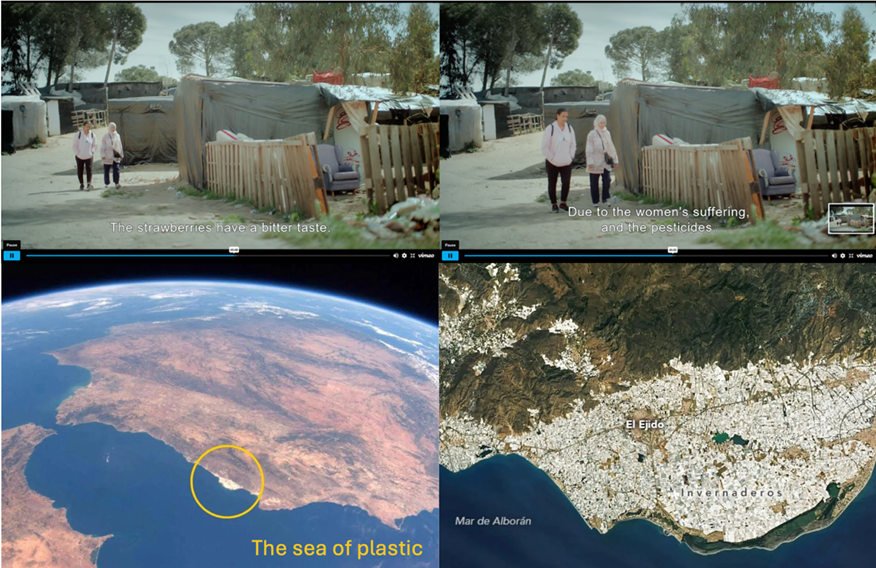
Screenshots from The Pickers (2024), directed by Elke Sasse, and satellite images of the “plastic sea”
Before defining the second central concept, Mediterranean ecocriticism, it is important to situate it within the umbrella term or larger field of environmental humanities. In recent years, Environmental Humanities have gained considerable traction by showing that the environmental crises are not only a matter for the natural sciences. Environmental Humanities challenges the long-standing division between nature and culture, and highlights that (neo)colonialism, extractivism, class structures, and broader systems of domination are at the root of the ecological and climate crises. Within Environmental Humanities, ecocriticism—positioned at the intersection of literary studies and environmental inquiry—is a particularly dynamic field. My project contributes to ecocriticism’s recent blue turn, which investigates the cultural, political, and ecological dimensions of seas and oceans. It takes the Mediterranean, with its long history of migration and environmental transformation, as its central focus.
I adopt the definition of Mediterranean ecocriticism proposed by Serenella Iovino, Professor of Italian Studies and Environmental Humanities, who edited a special issue of Ecozon@: European Journal of Literature, Culture and Environment on Mediterranean ecocriticism in 2013. This issue helped establish the subfield and provided a framework for studying the exponential growth of artistic works engaging with the natural-cultural compound known as the Mediterranean world. For Iovino, Mediterranean ecocriticism—and I would add, in line with postcolonial ecocriticism more broadly—should reject essentialist visions of the region as anti-historically pure, deconstructing any claim to a “pure” cultural origin, a harmonious cradle of “civilization,” or civilizational superiority. Thus, she argues, our task as ecocritics is not only to de-essentialize the Mediterranean but also to show it, through literature and cultural productions, as evolving, dynamic, and interconnected: a space of porous boundaries, intercultural encounters, and socio-environmental transformations.
Rather than a stable identity or center, the Mediterranean becomes a living assemblage marked by contingency, connectivity, and ecological-cultural entanglement. The Mediterranean ecosystem itself bears witness to centuries of migration and transplantation: oranges, tomatoes, eucalyptus, and cypress trees, now perceived as quintessentially Mediterranean, are in fact botanical migrants from extra-Mediterranean lands. The region’s landscape, like its cultures, is the result of layered movements, exchanges, and ecological transformations; of hybridity. Since Iovino’s special issue, research emerging mainly from Italian, English, and American Studies has sought to reframe Mediterranean discourses by focusing on marginalized humans (such as migrants and women) and on nonhuman animals—beginning with the Mediterranean Sea itself—leaving an important research gap in other linguistic contexts, such as French, Spanish, and Arabic.
Let us turn to one example with the Algerian series El’sardines (2025), directed by poet Zoulikha Tahar, that offers a striking example of the Mediterranean hybridity of languages, of a rich linguistic entanglement through the story of Zouzou, a 30-year-old bio-marine engineer, who is struggling to tell her family she is leaving to track down the mystery of sardines disappearing from Algerian Mediterranean waters. In an interview with the CNC (2025), Tahar speaks of the several languages used in her series and explains that in contemporary Algeria, parts of the population continue to alternate between Arabic and French, yet this fluctuation is itself evolving: French verbs are “Arabized,” and regional dialects such as Oranese circulate alongside standardized forms. She further explains that younger generations no longer systematically study in France; English is increasingly taught in schools; Middle Eastern television series exert a form of soft power across North Africa. In the same interview (2025), co-writer Kaouther Adimi notes that she used to speak French a lot with her friends, but that the “Generation Z” is speaking more and more English while Algeria is reviving its Maghrebi dialects. Linguistic hybridity here is not static mixture but an index of historical realignments, postcolonial negotiations, and shifting cultural affiliations. The Mediterranean emerges as a space of ongoing reconfiguration rather than inherited coherence, and the series reflects these shifts while also pointing to broader geopolitical reorientations.
However, recognizing hybridity must also be approached critically. As Cristina Lombardi-Diop has argued in Locating African European Studies (2021), an unreflective celebration of hybridity in Mediterranean discourse can risk neutralizing Blackness, dissolving specific histories of racialization into a generalized narrative of mixture. The language of connectivity may obscure structural inequalities if it glosses over asymmetrical power relations. This tension is particularly visible in the Spanish context, where Spanish-language Black productions continue to “remain invisible in Spanish universities and in the Spanish literary establishment” (p. 295), as Maya G. Vinuesa observes. Similarly, Stephen Small has emphasized the broader invisibility of Black communities within European national narratives.
A further example that complicates celebratory narratives of Mediterranean hybridity is Juan Tomás Ávila Laurel’s historical novel Dientes blancos, piel negra (2021). The novel reconstructs the life of the wealthiest Black woman in Equatorial Guinea, owner of the country’s largest cocoa plantation, who later established herself in nineteenth-century Barcelona. Drawing on the Afro-Iberian research project directed by anthropologist Yolanda Aixelà-Cabré, Ávila Laurel retraces the history of the krio fernandinos, an Afropolitan community descended from formerly enslaved Anglophone Africans who escaped bondage and formed a prosperous diaspora in the Gulf of Guinea.
In doing so, the text resonates strongly with the theoretical intervention of the Black Mediterranean. As editors of The Black Mediterranean: Bodies, Borders and Citizenship argue in their introduction, this framework enables “a radical re-telling of ‘Europeanness’ by locating questions of race and Blackness at the center of the region typically understood to be the ‘cradle’ of European civilization” (Danewid et al., 2021, p. 15). Rather than accepting the Mediterranean as a harmonious space of exchange and fluid hybridity, the Black Mediterranean concept challenges its idealization by foregrounding “oft-overlooked histories of racial violence and their contemporary reverberations” (Danewid et al., 2021, p. 14). Ávila Laurel’s novel exemplifies how literary narrative can expose these submerged histories.
Such a reframing is crucial when addressing contemporary migration. As Saucier and Woods insist, any discussion of migration in the Mediterranean “that does not ground itself in the historical context of slavery and colonialism is imagining a world that is not, rather than dealing with the world as it is” (2014, p. 60). The Mediterranean border regime cannot be separated from the longue durée of racial capitalism. The infrastructures that once sustained plantation slavery continue to echo in contemporary forms of coerced labor, precarious citizenship, and differential mobility.
Food provides a particularly revealing entry point into these structures. As Felipe Fernández-Armesto observes, eating constitutes our most intimate contact with the natural environment. Food and agriculture also connect historical slavery with present-day racial capitalism, a continuity visible across many of the cultural works discussed here. Through precarious legal status, debt, confiscated documents, and withheld wages, many migrants work below minimum wage in agricultural sectors across Southern Europe. European Union migration policies frequently render these workers “illegal,” precipitating relations of dependency that resemble forms of modern slavery. In doing so, they reproduce institutional racisms that once justified slavery and colonial expansion, now sustaining regimes of cheap or unpaid labor underpinning Mediterranean food production.
This reality is conveyed through different representative strategies. In non-fiction, the denunciation can be direct: in the trailer of the documentary The Pickers (2024), an interviewee declares, “Welcome to slavery” (1:12). The film makes explicit the structural violence embedded in contemporary agricultural systems. In fiction, by contrast, such critique may appear more obliquely. In Todo bajo el sol, two Black workers are shown harvesting watermelons in a vignette split between blue—evoking the Mediterranean Sea—and green, the cultivated field. Without overt commentary, the image visually sutures leisure and labor, tourism and extraction.
A similar articulation appears in the final episode of the series Dieciocho (2024), directed by Hammudi Al-Rahmoun Font. The episode, titled “Vivir”, opens with the protagonist Moha working in fields outside Valencia on the Spanish Mediterranean coast. Surrounded by other migrant men—none of them white, all speaking with different accents—he harvests onions while joking about football players from their respective countries. The scene resists reducing these workers to passive victims; through humor and camaraderie, they embody forms of agency within dependency. Yet this fragile agency is structurally constrained. Moha had previously worked legally in a kitchen, but once his residence papers are denied, the fields become his only option.
In the same episode, Moha learns that a close friend, also a migrant, has taken his own life. Alone in the field, he cries out in anguish, framed against an expanse of endless vegetables. The camera lingers on both his rage and the agricultural landscape that surrounds him, binding emotional devastation to material environment. Immediately afterward, the parallel narrative follows Celia, the other main protagonist, a university student in marine ecology. Asked by a professor about anthropogenic impacts on coastal and marine ecosystems, she lists pollution, plastic waste, overfishing, habitat destruction, biodiversity loss, and climate change. Al-Rahmoun Font places these scenes back-to-back without explicitly linking migration and climate crisis. Yet the juxtaposition performs the connection. The series assembles the pieces—racialized labor, precarious legality, environmental degradation—whose structural interdependence becomes legible when placed within our chosen frameworks.
Indeed, it is precisely here that the frameworks of the Black Mediterranean and Mediterranean ecocriticism become analytically productive. Rather than treating migration, racism, and climate change as separate issues, these approaches reveal their co-constitution. Mediterranean ecocriticism, as I propose it, insists on connecting these dots: making entanglements explicit by placing cultural works in dialogue with historical analysis and environmental science. The urgency of such dialogue is underscored by the findings of the Intergovernmental Panel on Climate Change (IPCC). The Mediterranean region is identified as a climate change “hotspot”, with warming occurring at rates approximately 20 percent above the global average and with significant declines in rainfall. Major risks include prolonged droughts, more frequent floods, erosion, heatwaves, intensified wildfires, sea-level rise, ocean warming, and acidification, threatening food security, human health and well-being.
When read alongside cultural productions such as The Pickers and Dieciocho, these scientific assessments acquire an embodied, emotional and relatable dimension. As the IPCC emphasizes, “sharing and co-production of knowledge can support climate adaptation practices and enhance sustainability in the Mediterranean region” (p. 2236). In this respect, the work of Mediterranean ecocriticism and the deployment of the Black Mediterranean concept—particularly in classrooms and public interventions—participates in such knowledge-sharing. By contextualizing and placing cultural representations of the Mediterranean in conversation with environmental data and historical analysis, ecocritical practice contributes to a broader effort of making structural entanglements visible.
This project, still at its beginning as part of a larger postdoctoral research trajectory, proposes precisely such a framework: one that reads literature, film, and series not as isolated cultural artifacts but as critical sites where racial capitalism, ecological crisis, and Mediterranean imaginaries intersect and can be collectively rethought.
Selected Bibliography
The Black Mediterranean Collective. (2021). The Black Mediterranean (G. Proglio, C. Hawthorne, I. Danewid, P. K. Saucier, G. Grimaldi, A. Pesarini, T. Raeymaekers, G. Grechi, & V. Gerrand, Eds.). Palgrave Macmillan. https://doi.org/10.1007/978-3-030-51391-7
Centre national du cinéma et de l’image animée. (n.d.). El Sardines : Les dessous d’une minisérie algérienne en quête d’émancipation. https://www.cnc.fr/series-tv/actualites/elsardines-les-dessous-dune-miniserie-algerienne-en-quete-demancipation_2410575
Danewid, I., Proglio, G., Hawthorne, C., & Heller, C. (2021). Introduction. In G. Proglio, C. Hawthorne, C. Heller, & I. Danewid (Eds.), The Black Mediterranean (Mediterranean Perspectives). Palgrave Macmillan. https://doi.org/10.1007/978-3-030-51391-7_2
Davis, A. (2020). We Can’t Eradicate Racism without Eradicating Racial Capitalism [Video]. YouTube. https://www.youtube.com/watch?v=qhh3CMkngkY
Freire, P. (2017). Pedagogy of the oppressed. Penguin Classics.
Intergovernmental Panel on Climate Change. (2022). Cross-Chapter Paper 4: Mediterranean Region. In H.-O. Pörtner, D. C. Roberts, E. S. Poloczanska, K. Mintenbeck, M. Tignor, A. Alegría, M. Craig, S. Langsdorf, S. Löschke, V. Möller, & A. Okem (Eds.), Climate Change 2022: Impacts, Adaptation and Vulnerability. Contribution of Working Group II to the Sixth Assessment Report of the IPCC (pp. 2233–2272). Cambridge University Press. https://doi.org/10.1017/9781009325844.021
Iovino, S. (2017). Mediterranean Ecocriticism. Interdisciplinary Studies in Literature and Environment, 24(2), 325–340. https://www.jstor.org/stable/26569774
Miller, C. L. (1990). Reading through Western Eyes. Theories of Africans: Francophone Literature and Anthropology in Africa, University of Chicago Press, pp.1-30.
Saucier, P. K., & Woods, T. P. (2014). Ex Aqua: The Mediterranean Basin, Africans on the Move, and the Politics of Policing. Theoria, 61(141), 55–75. https://doi.org/10.3167/th.2014.6114104
Small, S. (2018). Theorizing Visibility and Vulnerability in Black Europe and the African Diaspora. Ethnic and Racial Studies, 41(6), 1182–1197. https://doi.org/10.1080/01419870.2017.1360362
Vinuesa G., M. (2020). Negotiating Afroeuropean Literary Borders: The Inclusion of African Spanish and African British Literatures in Spanish Universities. In Locating African European Studies.
Watch again the lecture by Camille Lavoix in the Aula Mediterrània series.
Within the framework of