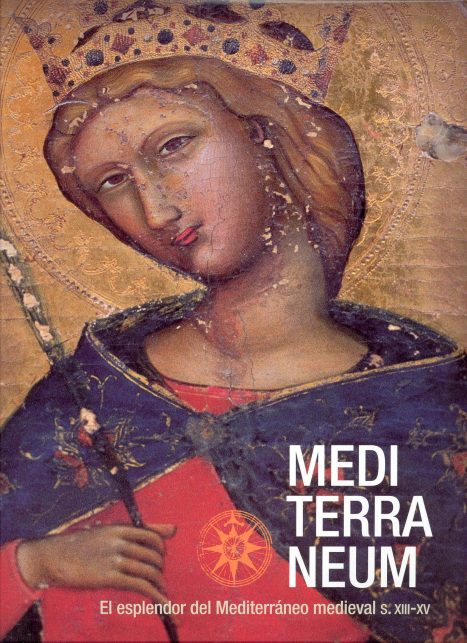

MEDITERRANEUM. Splendour of the Medieval Mediterranean (13th-15th centuries)
A book-catalogue that addresses the configuration and development of the Mediterranean world throughout one of the fundamental periods of its history: the Late Middle Ages, a time when the sea became a vehicle for exchange, commerce, culture, religion, which transformed the very essence of the Mediterranean by enriching the relationships between its different peoples.
MEDITERRANEUM could be visited in Barcelona from 19th May to 27th September 2004 within the framework of the exhibitions of the Universal Forum of Cultures Barcelona 2004.
The exhibition recreated life in the main cities of the medieval Mediterranean during the period of splendour of the Crown of Aragon, in the Late Middle Ages. It dealt with a historical time which was decisive for the Mare Nostrum, characterised by a marked contrast between moments of commerce, political exchange and cultural dialogue and others of confrontation between the powers and Mediterranean civilisations.
Through art, culture, navigation and commerce, MEDITERRANEUM allowed us to travel through a Mediterranean in which Barcelona and the Crown of Aragon played a major role and which had a significant influence on the definition of Catalan national identity. It was a world that accumulated centuries of political, economic and cultural development and was preparing to expand to new frontiers with the arrival of influences from the Far East through the Silk Route, the incorporation of areas such as the Indian Ocean or the coast of southern Africa and the opening of the Route of Flanders and the discovery of America.
The exhibition, which could be seen in the venues of the Museum of the History of Catalonia (art, culture, religion, power) and in the Barcelona Maritime Museum (navigation and commerce), includes more than 200 pieces from 80 museums and institutions from Egypt, Syria, Turkey, Italy, Denmark, Austria, Bosnia and Herzegovina, France, Holland, Germany, the United Kingdom, Portugal, Spain and Croatia.
It is possible to see paintings, sculptures, tapestries, books, ceramics, engravings and navigation instruments of great artistic and historical value which will allow visitors to view and understand the dialogue between Catholic Europe, Byzantine East, Mameluke Egypt and the emergent Ottoman world.
One of the main pieces of the exhibition is the Catalan altarpiece of Saint Catherine, a work commissioned to Martí de Vilanova in 1387 by the Catalan Consul in Damascus which was offered to the Monastery of Saint Catherine on Mount Sinai (Egypt), with which the Catalano-Aragonese Crown had strong links. More than six centuries later, the altarpiece returns to Barcelona for the first time.
Among other outstanding pieces, the exhibition included:
• The Nao of Mataró (late 15th century, Rotterdam Maritime Museum), the oldest model of a ship from the time. Original from Mataró, it returns for the first time to Catalonia. (127cm x 94cm x 122cm)
• The Turkish naval wars, watercolour by Katip Çelebi (after 1656, Topkapi Sarayi Müsezi, Istanbul)
• Astrolabe of al-Sahl al-Nisaburi (1180-1280, Germanisches National Museum, Nuremberg)
• The helmet of the Turkish Sultan Mehmed II the Conqueror (1444-1481, Instituto Valencia de Don Juan, Spain)
• Mongol Koran of Baghdad (1306-1313, Topkapi Sarayi Müsezi, Turkey)
• Statue of Saint George of Italian silver work, unique in Europe (1420-1430, Chapel of Sant Jordi, Palau de la Generalitat)
• Sculpture of the Doge of Venice Antoni Venier (1382-1400, Museo Correr, Venice)
• Mameluke copper washing tub with representations of court scenes (13th-14th centuries, Musée du Louvre).