



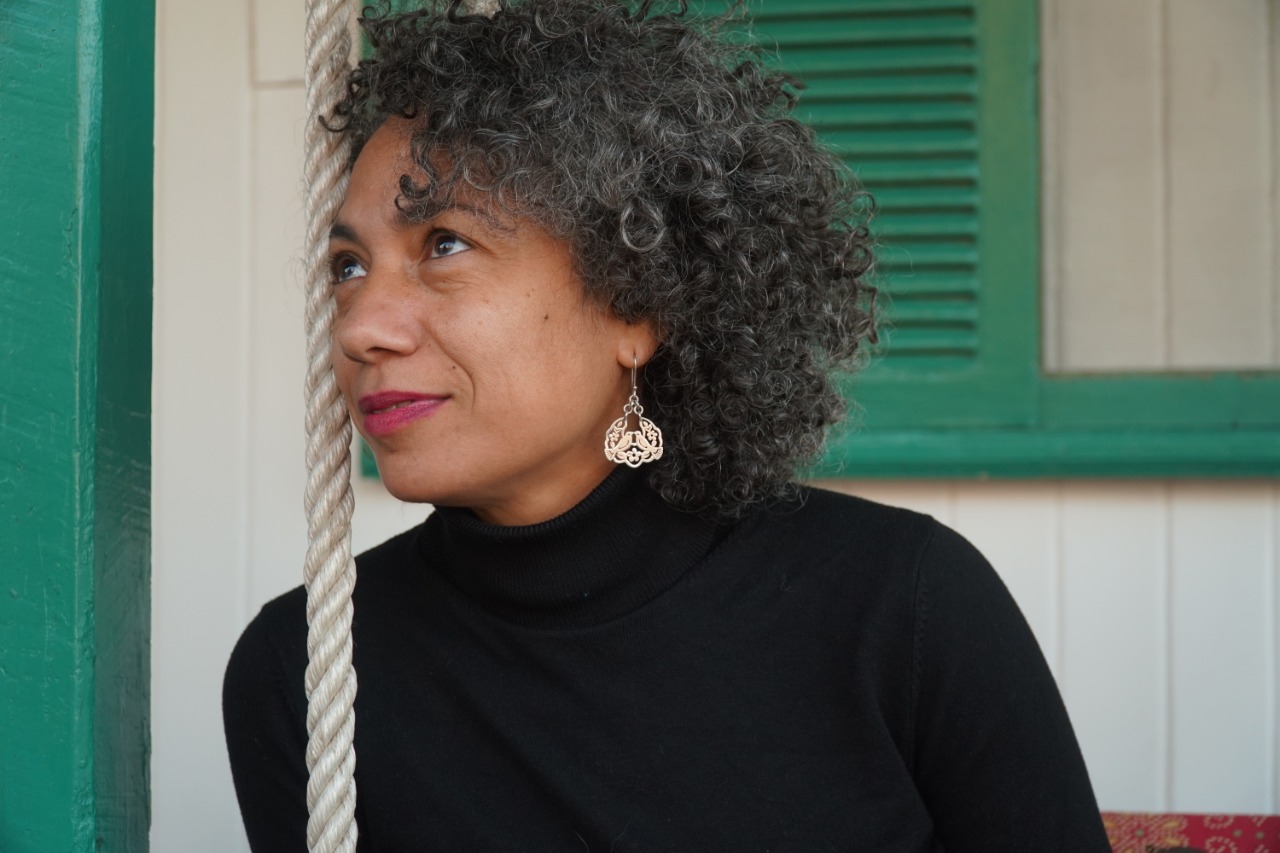
Between Cairo and Málaga, filmmaker Amal Ramsis reflects on cinema, politics, and cultural resistance. Founder of the BWFC, she advocates for a free and collective cinema beyond the power structures that dominate the audiovisual industry.
“I could make a film about someone privileged, but I do not know how they feel. I belong to the other side.”
Introduction
Amal Ramsis (Cairo, 1972) welcomes us from her home in a small village near Málaga, where she moved after the pandemic. We speak via video call. While connecting, she carefully checks a few emails. They are the final administrative details announcing the new film project she is currently working on and of which, for now, she only allows us to glimpse its intensity. What is it about? We will discover a little more throughout the conversation.
She greets us with an open smile and an attentive gaze, divided between the screen and the constant flow of incoming messages. It is a gesture that defines her: someone used to observing, recording, and never losing sight of what is happening around her.
Today, halfway between Spain and her native Egypt, Ramsis has built a career that crosses geographies and languages. She studied Law at Ain Shams University in Cairo and Cinema at Madrid’s Séptima Ars film school. In 2008, she founded the Cairo International Women’s Film Festival and launched the Between Women Filmmakers’ Caravan, an initiative that, over nearly two decades, has become a key space for circulation, encounter, and training among women filmmakers across the Arab world, Europe, and Latin America.
Her filmography, which includes titles such as Only Dreams (2005), Forbidden (2011), The Trace of the Butterfly (2015), and You Come From Far Away (2018), has been recognised at international festivals and reflects a way of working with the camera deeply rooted in commitment, territory, and lived experience.
In this warm conversation with Amal Ramsis, we reflect, among other things, on the Mediterranean as a space of tensions and competing narratives, on the role of cinema in shaping imaginaries, and on the urgent need to continue building networks and spaces for women creators and alternative voices. Her answers — clear and far removed from political correctness — reveal her unequivocal political commitment to socially engaged cinema and emerge from that genuine freedom that today can almost only be found at the margins of the industry.
Interview
1. The current issue of QM revolves around the myth of the Mediterranean. What does the Mediterranean mean to you today? What would that myth be?
In the Mediterranean, it becomes very clear that there is a South and a North. A space that defines itself as intercultural should not display such a profound difference between privileged countries and those that need support, and yet that inequality is very present because hierarchical relationships dominate. We speak a great deal about interculturality, about what unites us, about the Mediterranean being a “small lake,” but in practice these differences appear at many levels, especially economically. As harsh as it may sound, I believe that what truly unites us is simply a body of water. The Mediterranean is a geographical space in which we coexist, but we cannot say that there is a shared culture or an equal relationship between the two shores. We share a sea, but each country understands it differently.
We share a sea, but each country
understands it differently
2. To what extent do you think cinema contributes to building — or questioning — this hierarchical and unequal Mediterranean that you define as a border?
In the Mediterranean film industry, the relationship is usually quite clear: support almost always comes from Northern countries. That is the dominant logic. If we truly wanted to build a multicultural Mediterranean, it would make sense, for example, for many films to be subtitled into Arabic. However, European films are generally subtitled into English, but not into Arabic. In some way, we are left in the position of consumers of culture. The North produces, and the South receives and consumes. It is not an equal relationship. Moreover, within cinema, we often have to pass through the Northern Mediterranean in order to even get to know one another. It feels as though we first need recognition from the European market before our industry can be acknowledged. That is precisely why the Caravan emerged: as an attempt to deconstruct this deeply unequal structure.
3. Tell us about the Between Women Filmmakers’ Caravan, a project founded in 2008 that is now approaching two decades of existence. How has the project evolved? Are you satisfied with the path it has taken?
We never thought we would reach twenty years. It is a project that receives no state support in Egypt. None. The most important funding we receive comes from the Provincial Council of Bizkaia, but these are annual grants, so we never know whether the project will continue the following year. And yet, here we are. Without red carpets, without major support, sustained largely through the voluntary work of the whole team… and nearly twenty years have passed. That makes us very proud.
In recent years, the Caravan has also evolved into something more collective. It has become a shared project among a group of Egyptian and Lebanese women who work together not only on the Caravan, but also on promoting our own films. This is how the collective Ma’an (“together” in Arabic) was born. We formed it from participants in the documentary workshops we organised in 2019, and now we are collectively developing four documentaries. We are 21 women working together. We continue exploring alternative forms of production, far from the traditional model that depends on a producer who “falls from the sky” — or never arrives — and upon whom everything seems to depend. We wanted to break away from that logic and build our own, more autonomous model. It is also a way of having a freer, more rebellious voice that does not conform to stereotypical representations of Arab women.
We have created a collective of women who work
together without competition, in solidarity,
breaking with the competitive logic that dominates the market
4. Beyond this important collective shift, the very concept of a “caravan” suggests movement, networks, and community. Does it still mean the same thing to you today?
The Caravan still has a lot to do with creating bonds between women — meeting, dialoguing, and discovering our shared interests. It allows us to see the world through our own eyes. At first, we mainly thought of the Caravan as travelling film cycles: a project in motion that travelled, created networks, and allowed experiences to be shared. But in those early years, we never imagined we would also develop an alternative form of collective production.
Over time, almost without realising it, that model emerged, especially in Egypt and other Arab countries. The dynamics of the Caravan encouraged more women to join the project. Our workshops are based on solidarity among participants, and what is interesting is that after they end, many women continue working together. For me, that is the project’s most important meaning: that we have helped create a collective of women who can work together without competition, in solidarity, breaking with the competitive logic that dominates the market.
5. What is it like to be a woman working in cinema in the Arab world? Do you think the work of women filmmakers is truly recognised?
Sometimes people ask us: “But are there really Arab women directors?” And the answer is very clear: yes, there are many of us. In fact, many of the Arab films that reach major international festivals are directed by women. In countries such as Lebanon, for example, we have witnessed a real boom in women directors in recent years, especially in documentary filmmaking. The same is happening in Tunisia. At the last Berlinale, most of the selected Arab films were directed by women, and even the award for Best Short Film went to a Lebanese director (Yawman Ma Walad, Someday a Child). This shows that there is a very strong spirit and creative energy. The problem is that our work often remains invisible because Arab women continue to be represented from the outside as victims, passive figures associated with certain stereotypes.
That is why it is so important to make visible the women filmmakers who have their own voices and who are respected within their own countries. A very clear example is Kaouther Ben Hania (The Voice of Hind Rajab). She would never have reached the Oscars if she were not already considered one of Tunisia’s most important filmmakers. Part of our work consists precisely in making known the women who have helped build the film industry in our contexts. Because they have been there from the beginning. In Egypt, for example, the first producer in the film industry was a woman (Aziza Amir, 1901–1952).
6. And for you personally, what has your experience been like? How has your creative process as a filmmaker developed?
My experience has been somewhat different because I usually work at the margins of the industry. I try not to enter overly institutional production dynamics. In documentary filmmaking, at least, that is still possible. In fact, the documentaries I have made so far have never had producers. I have always tried to work freely, both in relation to censorship and to my own thinking. For me, cinema is a safe space, almost like writing in my own home. That is why I try to make projects that do not require large budgets and to work in a more artisanal way. It is a way of maintaining my freedom and avoiding dependence on market rules or industry logics.
7. Your films often address social themes and give voice to everyday heroes. Do you consider yourself an activist filmmaker?
I do not know if I would define myself exactly as an activist filmmaker. I do not strategically decide which stories I have to tell. They emerge more from my belonging to a reality, to certain people, to a context. I do consider myself someone committed to her society. Many years ago, I was very politically active. Today, I would not express it in the same way, but I still feel I have a role, especially in relation to younger generations. The ideas I work on do not come from a conscious choice but from closeness, from belonging. I could make a film about someone privileged, but I do not know how they feel; it is not my place. I belong to the other side. In that sense, both my cinema and the work we do through the Caravan — supporting other women filmmakers — have a political dimension. Not necessarily through explicit discourse, but through practice and commitment.
8. What projects are you currently working on? What will we see next from Amal Ramsis?
Right now, I am making a new documentary and, at the same time, working on my first fiction film. It is a different process because in fiction the rules of the game are different. After many years, I have come to accept that a film will not change the world. What matters to me is respecting myself. I am not willing to accept everything just to make a film. Now I can afford to set limits because I have more experience and I know very well the red lines I do not want to cross.to stop the advance of a caravan of women filmmakers accustomed to rocky terrain and to continuing the journey despite adversity. Screenings continued online, and since last year the project has returned to physical spaces through a Cairo cinema where one film is screened every two months on a regular basis, with a very positive response from audiences.
After many years, I have accepted
that a film will not change the world.
What matters to me is respecting myself
For younger generations, it is more difficult because the market can absorb you very quickly. If you are not very conscious from the beginning, the idea of fame or being present at major festivals can make you lose your direction. In my case, I can now take this step towards fiction also because I am not doing it alone. I feel accompanied by the group of women we have built; one of the producers and the cinematographer are part of the collective. We all share a way of understanding cinema that allows us to build the project from our own principles.
9. Why did you feel it was necessary to use fiction to tell this new story?
I believe that films, when they are born as ideas, already carry their own language within them. It is not that I first decide whether I am going to make a fiction film or a documentary. The story itself asks for it. The images I imagine, the way the characters are constructed… all of that already contains its own form. In this case, the project emerged as fiction from the very beginning. Now the project is in safe hands and in the funding stage, while I continue working simultaneously on the documentary.
10. Although you may not be able to reveal too much yet, what can you tell us about these two projects? What themes will they address?
The fiction film revolves around the idea of not falling into traps. As women, as human beings, we are constantly surrounded by traps, often invisible and even socially accepted, but which go against what we truly think or feel. It tells the story of a group of women who decide to fly pigeons in Cairo. In Egypt, managing pigeon towers has traditionally been a men’s game. Women have never done it. The film explores how these women try to break into that male space and cross that barrier. But at the same time, there is a contradiction. They make the pigeons fly, yet they want them to return to their nests… and in some way, that too becomes a trap. As for the documentary, it is also connected to Cairo. It focuses on young people who ride bicycles through the city carrying enormous baskets of bread on their heads, moving against the flow of traffic to distribute it. It is the story of one of these bread sellers, of one day in his life, literally moving against the current. I cannot say much more for now.