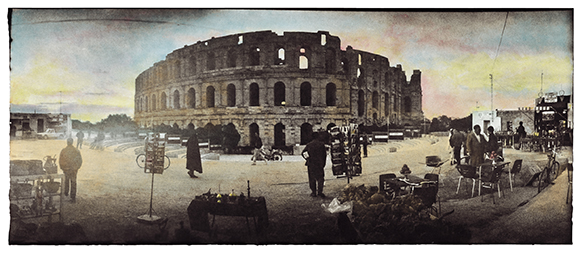


“Oh, the Mediterranean! Immense complexity!” wrote Josep Pla in his Notes disperses, an exclamation that continues to resonate as a synthesis of the difficulty − and fascination − with conceiving this sea. In this issue of QM, which explores the myths of the Mediterranean, we propose a closer look at the singular gaze of photographer Toni Catany. Although myths usually freeze the Mediterranean in idealised images or simplified narratives, his work opens up a different space: a plural, intimate, and changing Mediterranean, woven from geographical and emotional landscapes. In La meva Mediterrània (1991), Catany built a visual archive that challenges stereotypes and reveals the profound beauty of a complex and immense sea.

“I wanted, through images, to offer a personal version of a geographical and cultural space, complex and exciting, that I consider mine. My vision of this space starts from the Balearic Islands, as if they were its centre. From the rooftop of my house, in Llucmajor, looking south, you can see the island of Cabrera. I know that beyond there are other lands, the coast of Africa that invites me to dream…” − Toni Catany.
The exhibition “La meva Mediterrània“, which opened in February 1991 at the Casal Solleric in Palma de Mallorca, brought together the photographer’s visions after numerous travels: from Alexandria to Naples, from Llucmajor to Tetouan, from Djerba to Venice. Diverse in techniques but unified in aesthetic coherence, it sought to reflect territories and people, free from preconceived ideas, always with the desire to capture the essential beauty that transforms a landscape into a shared emotion.
The impact was immediate: the exhibition subsequently travelled to the Palau Robert in Barcelona, the Ateneu Mercantil in Valencia and, later, to the prestigious FotoFest in Houston. It also went to Bastia (Corsica), Terrassa, Duke University in North Carolina, and the Centro Nacional de Fotografía José Manuel Rotella in Cantabria. The experience also led to a book, La meva Mediterrània, which was recognised at the Rencontres Internationales de la Photographie d’Arles and awarded by the Government of Catalonia as the best illustrated book of the year.
Revisiting this work today also means revisiting a way of looking at the Mediterranean: far from the tourist postcard or the idealised myth, close to its human and cultural complexity.