



As the audiovisual world changes at full speed, a caravan of filmmakers has spent nearly 20 years opening alternative paths for women-made cinema in the Arab world. BWFC is a story of resistance and community from the margins.
In these turbulent times, when images slide past us at dizzying speed under the mantra of infinite scrolling; when streaming platforms have forever transformed the way we consume audiovisual content; when the emergence of new —or perhaps no longer so new— digital formats has democratized, and perhaps individualized, the use of the camera; and when artificial intelligence advances towards us like an unrestrained locomotive, threatening to blow apart the golden ratio that underpins the seventh art… one can glimpse, far away in the south, a caravan of women filmmakers raising dust on the horizon.
It is the Between Women Filmmakers’ Caravan (BWFC), a project now firmly established after nearly twenty years of journeying, which has become a nomadic space of resistance and creative freedom. Its original intention was not only to develop an innovative cultural initiative, but also to articulate a political commitment capable of promoting cinema created by women — across the world, certainly, but especially within Arab countries.
Far removed from major festivals and dominant industrial logics, the BWFC proposes both a geographical and symbolic displacement. Its aim is not limited to disseminating films directed by women; it also seeks to create alternative circuits for exhibition, production, and training, allowing new voices to emerge in contexts where opportunities remain scarce.
THE ORIGIN: A SHARED NECESSITY
The birth of the Caravan responds to a clear reality: the lack of accessible and sustainable spaces for women filmmakers to showcase their work, especially in contexts such as the Arab world, where the conditions surrounding production and cultural circulation still present significant challenges and glass ceilings. Its very name evokes the idea of movement, of travelling between territories, but also of an itinerant community.
Everything began with an idea by the Egyptian filmmaker Amal Ramsis (Cairo, 1972). In 2008, with the support of other women, the BWFC set its engine in motion for the first time in Cairo — its point of departure. “We wanted to deconstruct structures that were not egalitarian. To weave networks of exchange directly between women creators, without the need to pass through the North. We always look to the North as a compass, but we can orient ourselves in other directions”, explains the Egyptian director, referring to the dynamics of the film industry, which tend to place privileged countries at the centre while pushing others towards the periphery.
At that time, there was no similar initiative in the Arab world. There was no women’s film platform or festival created by women. There were festivals about women, certainly, but as Amal insists, “we are not objects; we are the creators of our works and of our own voices.” In this regard, Ramsis highlights Barcelona’s Mostra Internacional de Films de Dones de Barcelona (MIFDB), as an inspiring example that served as a model for the Caravan. In fact, two films from its selection were screened during that first inaugural edition in Cairo.
AN EXPANDED GEOGRAPHY: FROM THE ARAB WORLD TO LATIN AMERICA
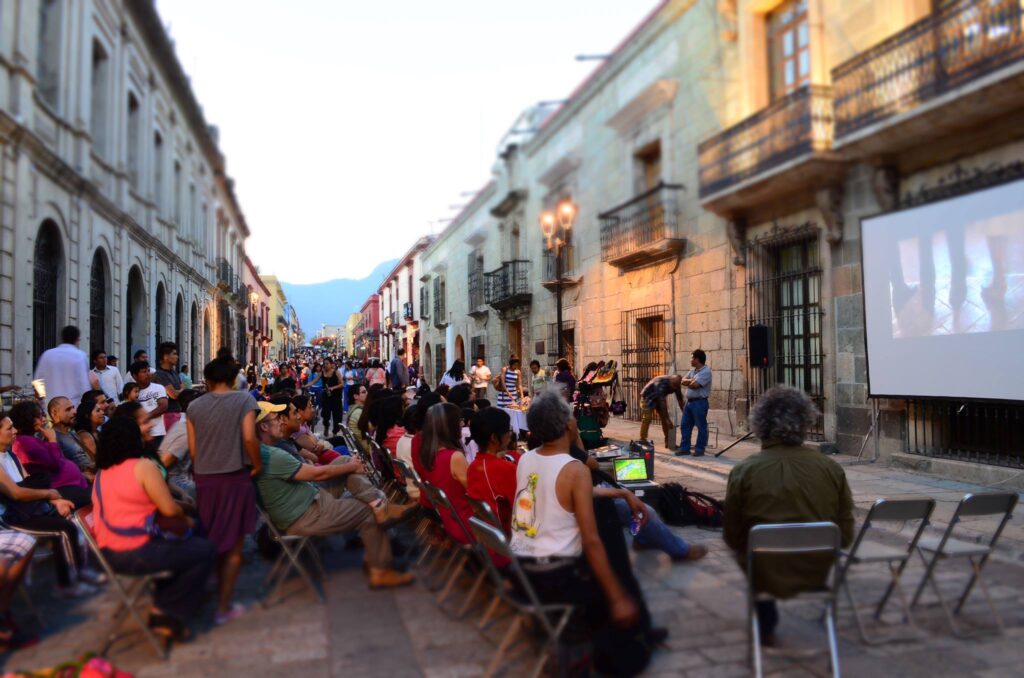
Although its origins lie in Egypt, the BWFC has gradually woven a network that transcends borders. Its activities have unfolded across different countries in the Arab world, but also throughout Europe and Latin America, shaping a transnational space for the exchange and circulation of experiences. The Caravan’s first route was already conceived with a long-term perspective. It bore the name Arab-Ibero-American Women Filmmakers’ Caravan. “When we created the Caravan, we realized that Arab and Latin American countries share many things in common economically and socially; we face similar conflicts,” explains the Egyptian filmmaker.
This international dimension does not respond to a logic of expansion, but rather forms part of the project’s conceptual core. The Caravan is understood as a bridge between diverse contexts, where filmmakers can share challenges, strategies, and cinematic languages. Through this dialogue, both local specificities and shared resonances emerge, generating a more complex understanding of the conditions under which women’s cinema is produced.
The connection with Latin America is particularly significant. Beyond cultural and geographical differences, there are clear parallels in terms of structural inequality, access to resources, and struggles over representation.
BEYOND EXHIBITION: TRAINING AND MENTORSHIP
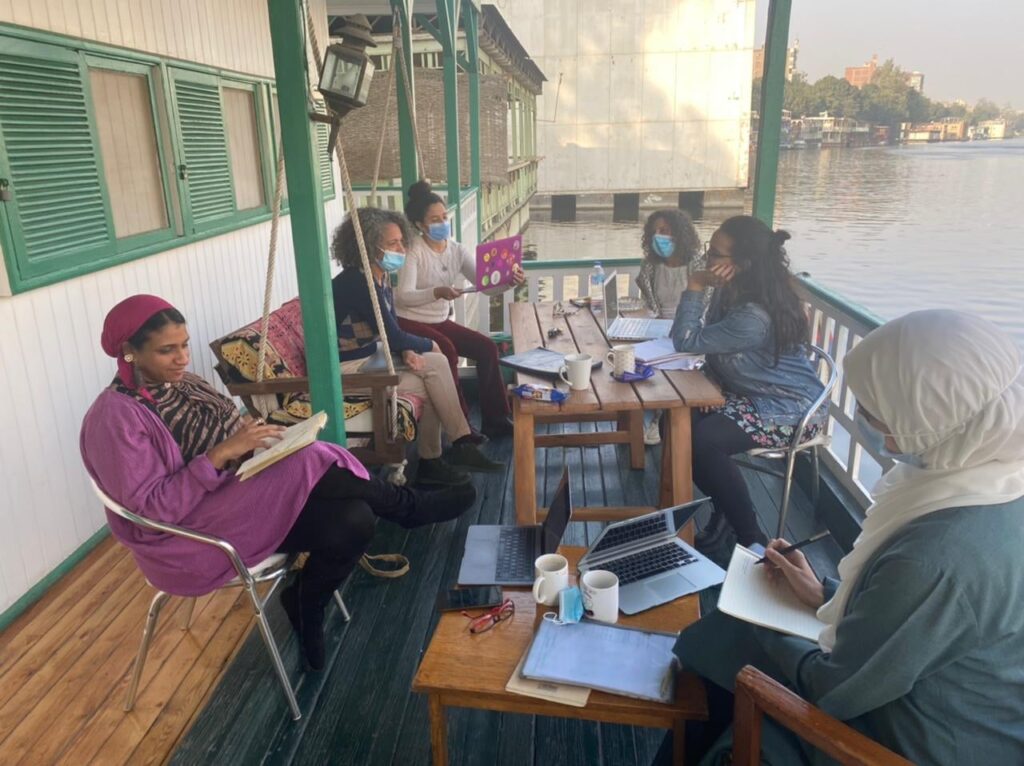
One of the elements that distinguishes the Caravan is its commitment to a comprehensive approach. Unlike other initiatives focused exclusively on dissemination, the project places training and mentorship for emerging women filmmakers at its core. Through workshops, consultations, and mentoring processes, it fosters the development of a new generation of directors who not only acquire technical tools, but also become part of a network of support and collaboration.
This emphasis on training is no coincidence. It stems from an awareness that inequalities within the audiovisual field are not limited to access to exhibition, but extend across every stage of the creative process: from writing and production to financing and distribution. Intervening at these different levels therefore implies a long-term strategy aimed at transforming the ecosystem as a whole. “All our workshops are free. Above all, we support women who have talent and want to make films, who have ideas, but lack the necessary resources,” explains Ramsis, referring to the Creative Documentary training programme that the Caravan offers over the course of a year, focusing on the entire filmmaking process and culminating in the production of a short film. “In Cairo alone, we receive more than 300 applications every year, and we select only eight,” she adds.
In this sense, the Caravan proposes a model of production that moves away from traditional competitive dynamics in favour of more collaborative logics. Sharing resources, knowledge, and contacts becomes a way of counteracting structural barriers while building lasting bonds among participants. Because, as Amal Ramsis explains, “the women we work with give and receive, they learn, but they also have a great deal to offer to one another.”
THE CARAVAN’S ROUTE: PAST, PRESENT, AND FUTURE
Since its founding in 2008, the project has already travelled a long road. In 2013, it became the Cairo International Women’s Film Festival. From screening 15 films in its early years, by 2018 it had grown to showcase 85 films across five cinemas in the Egyptian capital. From that point onward, however, the festival came to an abrupt halt due to the tightening of censorship under Abdel Fattah el-Sisi’s government. Then came the COVID-19 pandemic, yet even that was not enough to stop the advance of a caravan of women filmmakers accustomed to rocky terrain and to continuing the journey despite adversity. Screenings continued online, and since last year the project has returned to physical spaces through a Cairo cinema where one film is screened every two months on a regular basis, with a very positive response from audiences.
Today, the Caravan is more alive than ever, extending through multiple branches and routes. Confirmed stops include Amsterdam and Bilbao (both this May), Granada, Lebanon, and several cities in the Nile Delta and northern Egypt. And these will not be the only ones. Each year, twenty beautifully crafted films produced over the previous two years are selected, and the hosting spaces choose the titles that best fit their programmes.
In addition, the BWFC continues to develop new activities which, in 2026, aim to consolidate the momentum initiated in the previous edition. These are spaces for exchange and learning — perhaps the very alloy from which the fuel that keeps the Caravan moving forward is forged.
One of these initiatives is the Between Filmmakers Lab consultancy programme, which, for the first time, is also open to men. The goal is to create spaces for dialogue where filmmakers with projects in early development, production, or editing stages can exchange perspectives with women specialists in order to incorporate a gender-sensitive perspective into their films. “We offer a space to speak openly and discuss ideas among peers,” explains Ramsis. Three annual open calls are launched across the Arab world, receiving around 250 applications. Only three projects are selected each year. So far, the experience with Moroccan, Syrian, and Sudanese directors has been very positive. The eighth call for applications is already open until June 5.
The second initiative, also launched a year ago, is aimed at schools, universities, cultural centres, and educational spaces. This is the Educational Programme, designed so that teachers and educators can use cinema to complement their teaching programmes. The initiative includes three catalogues featuring films selected around three themes: Palestine, Gender, and Resistance for the Land. All the films, as always, are directed by women. To date, the Palestinian film catalogue has generated the greatest interest, accounting for 90% of requests.
A CINEMA IN MOTION: NETWORKS, COMMUNITY, AND POLITICS
The Between Women Filmmakers’ Caravan has demonstrated a remarkable capacity to generate community. The initiative has built a relational fabric connecting filmmakers from different contexts, facilitating the exchange of experiences and mutual support. This communal dimension also carries a political significance. In a field such as audiovisual production, where hierarchies and inequalities remain persistent, the creation of horizontal networks constitutes a form of resistance. Against the logic of competition, the Caravan proposes an ethic of collaboration that redefines the ways cultural production can take place.
Now approaching its twentieth anniversary on the road, the Caravan continues to move forward. In a world where images are a contested terrain, initiatives like this remind us that cinema can be far more than entertainment. Through collaboration, from the margins, and through an explicit desire for social and cultural transformation. “We have always wanted to create a bond between women filmmakers; to discover our shared interests; to see the world through their eyes.”
This is not simply a project about films made by women. It is another way of making cinema. A cinema in motion.