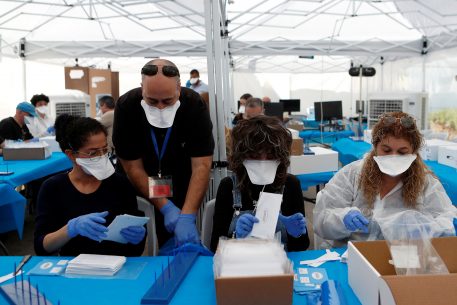
In the span of a few months, the pandemic of COVID-19 has spread to every corner of the world. The socio-economic repercussions of this crisis will be extremely far-reaching, and will likely unfold for years to come.
Advances made at the level of closing the gender gap in education and health have yet to materialize into propelling women to decision-making spheres, whether in the household or the public sphere.
The Israeli authorities now have de facto total control of the West Bank, achieved thanks to years of occupation that turned the territory into an Israelized extension of the Jewish State, with Palestinian enclaves surrounded and suffocated by illega...
The Barcelona Process turns 25 at a time when COVID 19 is putting a strain on the responsiveness of governments, the resistance of economic systems and the resilience of populations almost all over the world.
The Israeli political landscape, which seemed for a while to be heading in the direction of leadership change, turned the other way. Netanyahu managed to navigate the political system to his benefit and to dismantle his key opposition .
Regional economic differences have increased during the last two centuries. Today, there are strong inequalities in the region, with a clear distinction between North and South.
In 2021, Euro-African relations will reach a turning point. The sixth Africa-EU Joint Strategy Summit, an event launched ten years ago, will be unlike the others on more than one count.
The Middle East and North Africa region has been of growing importance to Beijing for the past two decades. This has been predominantly due to China’s need to ensure its energy security.
2020 has been a peculiar year for European Union (EU) migration policies. The closure of EU external borders and the suspension of asylum applications throughout Europe has turned Fortress Europe into a reality.
Over the course of the 2010s, relations between the United Arab Emirates and several countries of the Western Balkans have increasingly tightened. Starting from 2010, good relations have been propelled by a boom of investments.
Lebanon’s luck ran out in 2019. The country’s unsustainable debt, bad governance, internal contradictions and vulnerability to foreign interference, finally caught up with it, sending the country into economic freefall.
Sign up for our newsletter and be up-to-date with upcoming events and latest publications.
Please, choose language:
English Spanish Catalan French
This will close in 0 seconds