




It was October 2011, seven months after the Syrian uprising began. Autumn in Palmyra felt strangely calm, as though the city were holding its breath. Then, one afternoon, groups of young men began to appear, arriving on motorcycles by the dozen. They gathered in the ancient city of Palmyra, in front of the Arch of Triumph, the ancient theater, and the Temple of Bel,to protest the Syrian regime, carrying handmade signs with slogans scrawled in both English and Arabic: “Down with the dictator Bashar al-Assad.”
Most of them hid their faces beneath balaclavas, careful not to be recognized. I was there too, but instead of a sign, I held a small camera that a tourist had once given to me as a gift. In that moment, I felt caught between two worlds: part of the crowd, yet apart from it, witnessing something larger than myself unfold.
For 54 years, Syria was ruled by the Assad family: first Hafez al-Assad (1971–2000), and then his son, Bashar al-Assad (2000–2024). Their governments maintained power through a network of intelligence agencies, military control and violent suppression of dissent.
The uprising that began in 2011 as a peaceful call for reform quickly spiraled into one of the most devastating conflicts of the 21st century. Over half a million people were killed, and millions more became refugees. Shelling, airstrikes, and sieges flattened entire cities, including Raqqa, Aleppo and the suburbs outside Damascus, Syria’s capital. Cultural heritage spanning thousands of years was looted or destroyed.
I grew up in Palmyra, a kind of ‘island city’ in the middle of the Syrian desert, 180 km away from the nearest town. We were about 80,000 people, and almost everyone knew each other. The main source of income was tourism, as visitors came to see the famous ancient city that had stood for thousands of years. Like many others in Palmyra, I began working as a tour guide in the city and the surrounding desert, telling stories of the ancient ruins and empty places to people who had traveled thousands of kilometers to be there. I learned my English on the streets, speaking to tourists.
This was my life until 2011. It was then, in my early twenties, surrounded by friends with whom I had grown up and gone to school, that I found myself forced to take a side. I chose the side of the revolution. At first, I didn’t know what I was doing. I couldn’t bear to hold a gun, so I held a camera instead. I was fueled by a desire to show others what was happening, and the hope that this footage would be seen and shared. The regime had cut communications in the city to isolate us from the rest of Syria and the world. To reach the outside world, we first used satellite phones, and later a satellite internet provider. The internet was slow, so I would give the footage to a friend, and he would upload it. Within days the footage spread like wildfire online, first on Arabic channels like Al Jazeera and Al Arabiya, and then across other major news outlets in the Arab world, activist websites, and Syrian revolution social media pages. The Syrian regime went into a frenzy, searching for the person who had filmed it.
One very cold, dry desert night, my father received a call from a family friend in the police force: I was going to be arrested. I had to leave the city immediately. That was the start of my journey as a refugee, a journey of exile that lasted 12 years. My life unfolded in fragments: Damascus to Amman, Istanbul to Copenhagen, and finally Paris. Along the way, I worked on almost every kind of story linked to Syria: from camel smugglers in the Syrian desert, to human traffickers, to the desperate boat journeys of Syrian refugees from Turkey to Greece. I documented war crimes. My camera, and my work in journalism, was my way to bear witness. I documented everything I could, I’m searching for justice in every story I do.
My camera, and my work in journalism,
was my way to bear witness. I documented
everything I could, I’m searching
for justice in every story I do.
Being away from home, being a refugee, I poured my pain and anxiety into stories. Storytelling became my survival tool. I didn’t care what form it took: film, reportage, article, podcast. Often the story itself determined the form. All the while, I dreamt of going home, but like millions of Syrians, I could not.
Years passed, and I settled in Paris, where I started a family. I began to dream of taking my son to Palmyra, telling him stories about my hometown so he would come to understand my — our — homeland. When I promised him that I would take him to the desert, I imagined myself growing old near the sands I loved, and dying peacefully there. But the dictatorship still in Syria.
That dream, and these stories, made it easier to survive my homesickness. As an immigrant, you try to forget your memories of home, to delete them. But how can you erase 22 years of your life and hundreds of years of your family’s roots?
After eight years in exile, in 2019 I began making Ashes, a documentary co-produced by Antipode Films (Norway), Zadig Productions (France), and Bel Studio (Syria). While searching for justice, I met fellow Syrians Anwar and Amjad, two human rights lawyers living in exile in Berlin.
By chance, they recognized, in a supermarket, the officer who had tortured them years earlier in Syria. That encounter led to the first case in Syrian history against a former Syrian intelligence officer and marked the beginning of their pursuit of Syrian war criminals.
This moment sparked something in me. It became the starting point for Ashes, a personal, archival, and political film about Syrians who choose to fight for justice.
I followed them closely with my camera, in courtrooms, in their office, and throughout their everyday lives. I was there during moments of exhaustion and hope as they tracked down one criminal after another, people who had hidden among us as refugees.
In this film, the victim, the perpetrator, and the director are all Syrians. Through this work, I feel that I, too, am pursuing a form of justice.
And then, the unimaginable happened.
The Syrian regime fell.
It collapsed during a joint offensive led by Syrian opposition forces from the north, rebels, army defectors, and even extremist groups that seized the opportunity. Hezbollah had been weakened in Syria by Israel. Iran’s influence in the region had diminished. Russia was preoccupied with its war in Ukraine.
We thought it would be like the previous uprisings: it would begin with momentum, then gradually lose strength and be crushed. But this time was different. The opposition forces reached Damascus. Bashar al-Assad fled to Russia with his inner circle. In the early hours of 8 December, the regime fell.
Syria was free.
The dream became reality, and reality felt like a dream. The dictator had fallen.
It was time to go home.
And so Ashes moved from the courtrooms of Germany, where justice was being pursued far from the scene of the crimes, to Syria itself, where the crime scene remains, but where no courtroom yet exists. The film became a journey back to a country emerging from decades of dictatorship, asking what justice means when a regime has fallen, but its wounds remain open.
Ashes became a journey back to a country
emerging from decades of dictatorship,
asking what justice means when a regime
has fallen, but its wounds remain open
Early in the morning of December 10th, I crossed from Lebanon into Syria after 12 years away. Like Ulysses, after a long, winding, perilous journey far from home I had finally returned. The world shattered before me, as tears swam to my eyes. My heart was dancing, crying, bursting all at once.
I thought I had forgotten the smells of the streets, the faces of the people. I thought it would feel like arriving in a new country. But that wasn’t true. Everything came back, as if time had stopped for 12 years and suddenly started again. I remembered every detail, every memory, both good and bad. At last, I was home.
Now, I had to return not only to my country, but to my dream.
I documented everything linked to justice, I saw through photos, videos, and words: the secret underground prisons, the celebrations of the regime’s fall in public squares, the markets, the mosques, everything. I didn’t sleep for days, moving from one city to another, afraid to miss anything if I shut my eyes for even a moment.
Then I went to Sednaya Prison, considered the most terrifying in the modern world, where thousands of Syrians had been imprisoned, tortured, and disappeared during the regime. The day before I arrived, civilians living nearby took control of the prison and released the remaining detainees. Thousands of documents still lay scattered across the ground. It had always been a dream to know what this place looked like, one of the most terrible and monumental stories of the civil war. Now, after the dictator fled, I entered with my camera to document it.
The people around me, who had come in search of loved ones, were stunned at the empty cells they found. They started searching, believing there might be another secret prison underground, where they might find their brother, their son, their father. With crude tools made by local craftsmen, they began testing the earth. Among them was a 30-something man named Ahmad, searching for his brother, who had disappeared 10 years prior and was believed to be held in this jail. Suddenly he shouted: “There’s a hollow here!”
Hundreds of us gathered around: some digging, some cheering, some waiting. But in the end, it was only an illusion. There was no one underground; no missing loved ones. Perhaps they were in another prison, but not in Sednaya. The dead were taken to the morgue, while other prisoners who survived wandered Damascus aimlessly, broken in spirit, hoping their families might still recognize them.
I continued onward to Palmyra, my hometown.
When I arrived, I found that the ancient arch, under which I had once filmed the protests, was destroyed. The ancient theater, the temples — those, too, had been destroyed. The museum had been looted, the statues beheaded. Even my childhood home lay in ruins. The only thing left to remind me of my family was a small inscription written on the wall of my childhood room: my name and the names of my brothers, scribbled by my brother when he fled Syria five years after I did, after ISIS had taken control of the city.
In Palmyra, countless people had been killed and the town destroyed in stages by ISIS, the Russians, the Syrian regime, and the Iranians. Remnants of these successive occupations were still visible in the deserted Russian military bases, or in the citadel, where Putin’s picture hung and Russian newspapers lay scattered across the floor. Iranian flags still waved at former checkpoints and on the doors of five-star hotels, which they had taken as their barracks. A new Syrian army officer gave me a tour of the airfield and showed me the landmines now covering the region. More than 30 people had already died from those mines, among them a child named Mazen, who was killed in an explosion. I later saw on social media that the same officer who gave me this tour was himself killed by a mine.
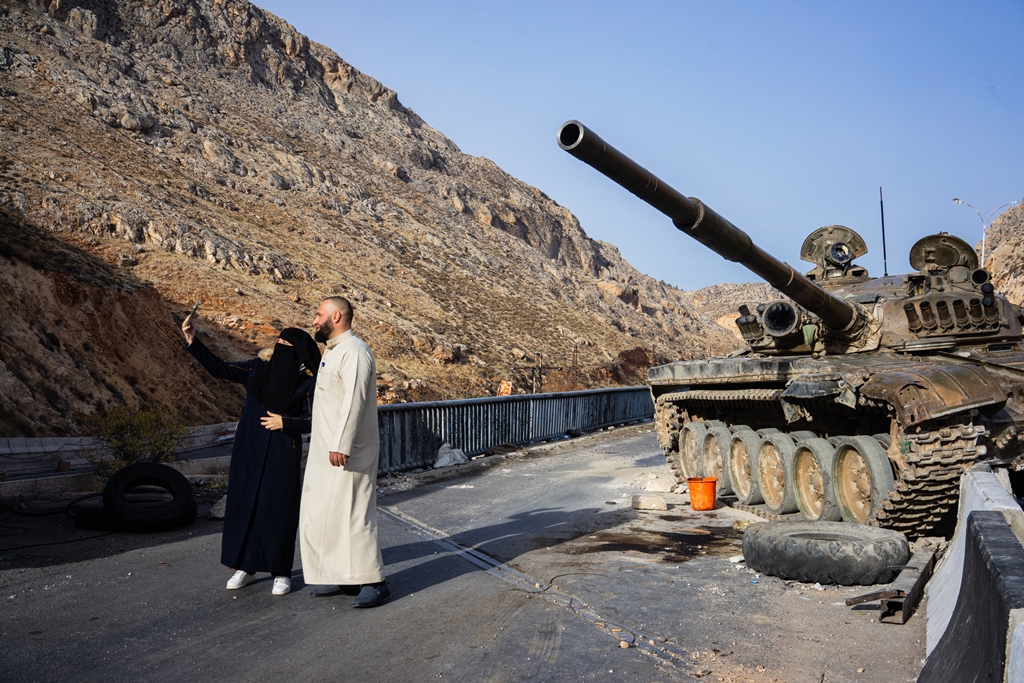
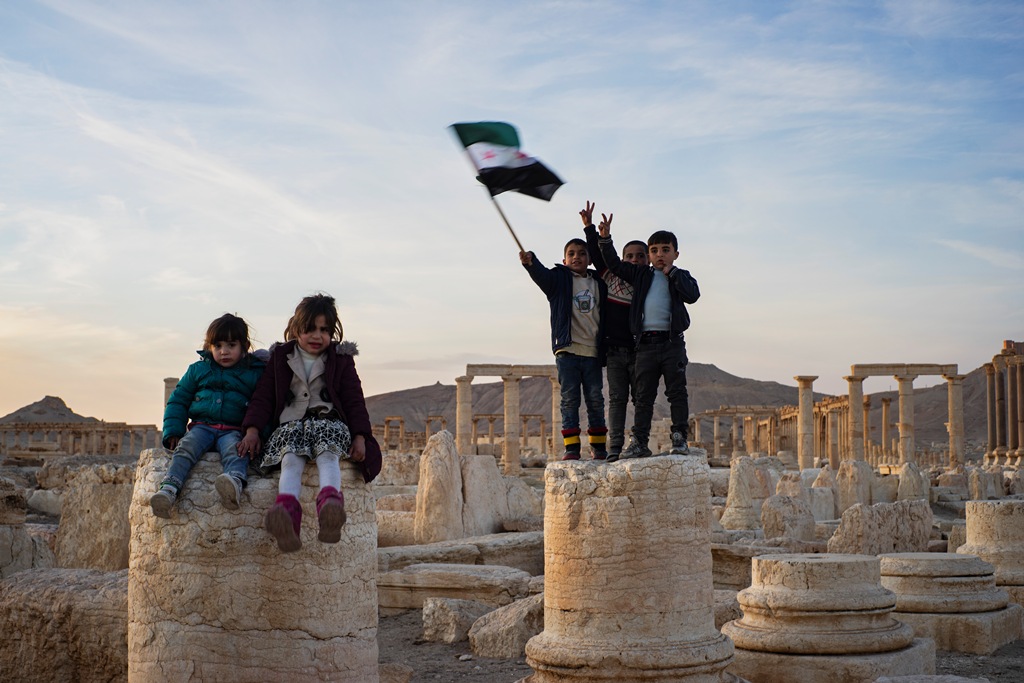
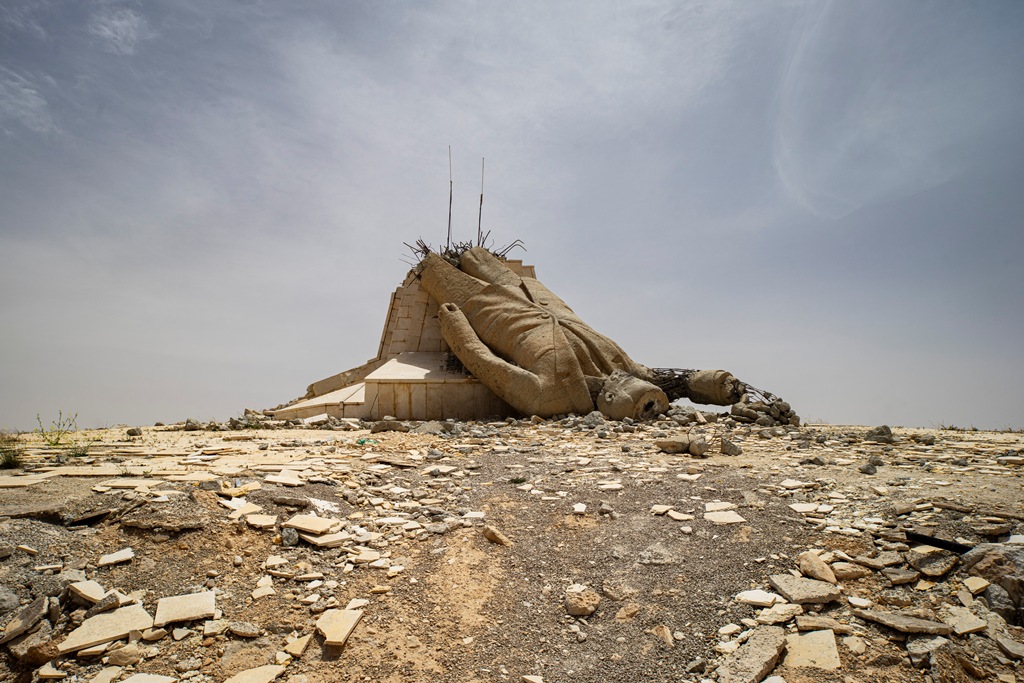
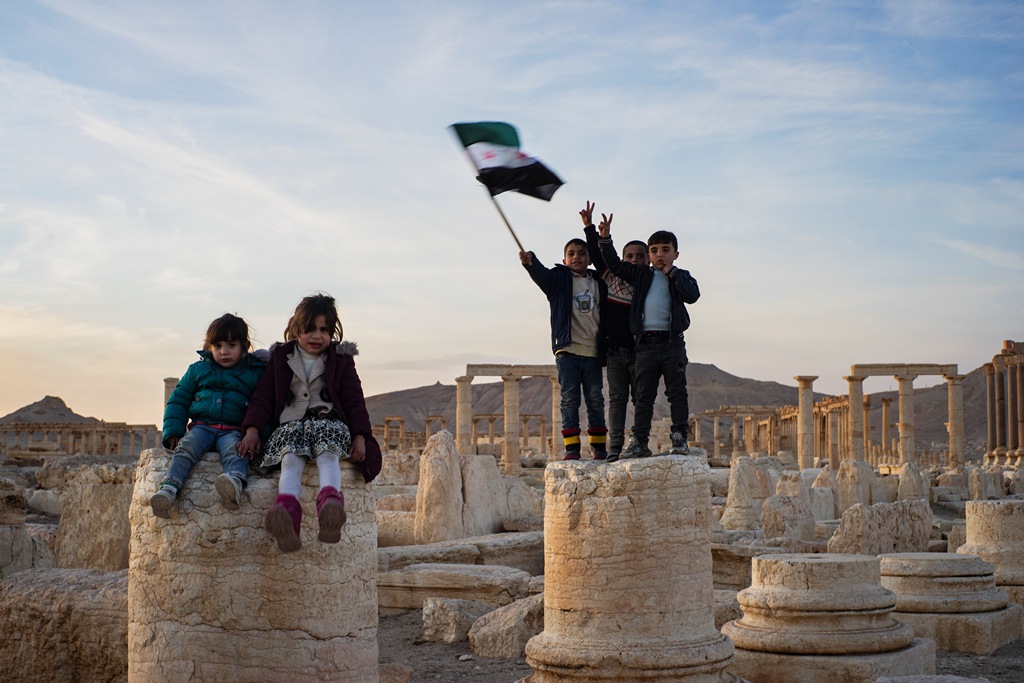
This series of photos spans from December 2024 to May 2025, following my journeys through Palmyra, Damascus, Homs, Aleppo, the Syrian Desert, and Sednaya Prison. It captures the ruins of dictatorship, the weight of memory, and the fragile first steps of a country emerging from decades of fear.
The fall of a dictator is not the end of a war; it is the start of a reckoning. These photographs show a Syria poised between grief and possibility. Entire cities are in ruins, but flags of revolution flutter again. Prison doors are open, yet the missing are still unaccounted for. Statues have fallen, but the wounds of half a century will take far longer to heal.
The new government that came to power is led by former members of al-Qaeda. They claim that they have changed, leaving their bloody and violent past behind. Their group was once called al-Nusra, before being rebranded as Hay’at Tahrir al-Sham (HTS). Now, they are in power in Damascus.
The dictator is gone, but some of his behavior remains. Since the beginning of this year, there have been many human rights violations: One massacre took place on the coast against the Alawites — the clan of the Assads — and another took place in the south, near the Jordanian border, against the Druze. In turn, the Druze carried out a massacre against the Bedouins. The civil war has not ended; sectarian violence remains a constant threat. The effects of the conflict and the cycle of killing continue, and the chaos of politics still dominates daily life.
For me, returning meant standing
before my destroyed home, the place
I once fled from to save my life. For Syria,
returning means confronting both the rubble
of its cities and the ghosts of its past
For now, the new government is supported by the US, and the new president of Syria, Ahmed Hussein al-Sharaa, has even made his first official trip to Paris. Promises of investment in Syria have been announced, and the sanctions that once targeted the Assad regime have now been lifted.
But will Syria survive this new phase of civil war? The coming months will reveal the answer; whatever happens, my camera will keep filming, documenting everything it can.
For me, returning meant standing before my destroyed home, the place I once fled from in order to save my life. For Syria, returning means confronting both the rubble of its cities and the ghosts of its past.
The story these images tell is not one of instant redemption. It is the story of a people reclaiming their narrative, piece by piece. It is about memory as resistance, about truth as justice, and about how even in the silence after gunfire a country must learn how to breathe — and live — again.