


The Barcelona Process: Euro-Mediterranean Realpolitik?
3 December 2025 | News
By Senén Florensa. Ambassador. Executive President of the European Institute of the Mediterranean (IEMed)
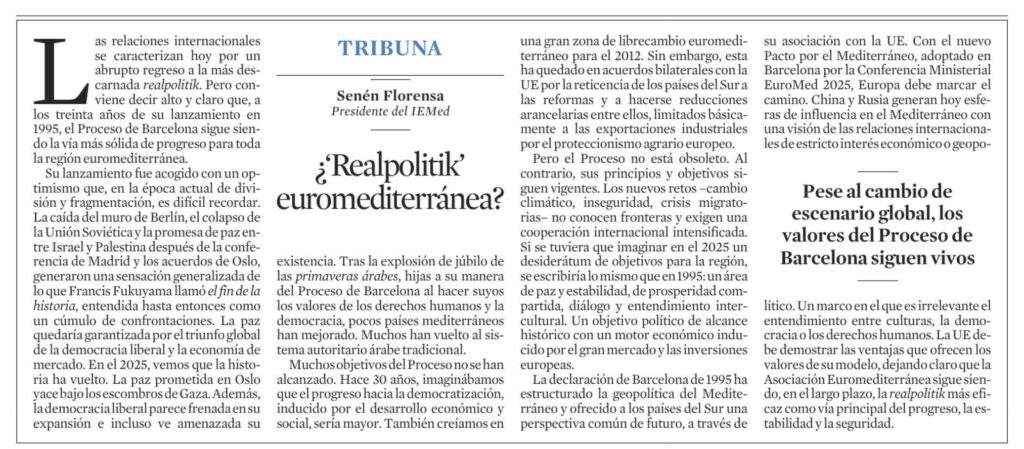
International relations today are marked by an abrupt return to the most unapologetic realpolitik. But it should be stated loud and clear that, thirty years after its launch in 1995, the Barcelona Process remains the most solid path of progress for the entire Euro-Mediterranean region.
Its launch was met with an optimism that is difficult to recall in today’s era of division and fragmentation. The fall of the Berlin Wall, the collapse of the Soviet Union, and the promise of peace between Israel and Palestine after the Madrid Conference and the Oslo Accords generated a widespread sense of what Francis Fukuyama called the “End of History,” understood until then as a succession of confrontations. Peace would be guaranteed by the global triumph of liberal democracy and the market economy.
In 2025, we see that history has returned. The peace promised in Oslo lies beneath the rubble of Gaza. Moreover, liberal democracy appears stalled in its expansion and even sees its very existence threatened. After the eruption of jubilation during the Arab Spring—daughters, in their own way, of the Barcelona Process for embracing the values of Human Rights and Democracy—few Mediterranean countries have improved. Many have reverted to the traditional Arab authoritarian system.
Many goals of the Process have not been achieved. Thirty years ago, we imagined that progress towards democratization, driven by economic and social development itself, would be greater. We also believed in a large Euro-Mediterranean Free Trade Area by 2012. However, this goal has been reduced to bilateral agreements with the EU due to the reluctance of Southern countries to implement reforms and reduce tariffs among themselves, and it remains limited mainly to industrial exports due to Europe’s agricultural protectionism.
But the Process is not obsolete. On the contrary, its principles and objectives remain valid. The new challenges—climate change, insecurity, migration crises—know no borders and demand intensified international cooperation. If one had to imagine in 2025 a desideratum of objectives for the whole region, it would be the same as in 1995: an area of peace and stability, shared prosperity, and intercultural dialogue and understanding. A political ambition of historic scope with an economic engine driven by the large market and European investment.
The 1995 Barcelona Declaration has shaped Mediterranean geopolitics and offered Southern countries a shared vision of the future through their association with the EU. With the new Pact for the Mediterranean, adopted in Barcelona by the EuroMed Ministerial Conference 2025, Europe must set the course. Today, China and Russia are creating spheres of influence in the Mediterranean based on a vision of international relations governed strictly by economic or geopolitical interest—a framework in which understanding between cultures, democracy, or human rights is irrelevant. The EU must demonstrate the advantages offered by the values of its model, making clear that the Euro-Mediterranean Partnership continues to be, in the long run, the most effective realpolitik as the main path toward progress, stability, and security.
Op-ed published on the print issue of the newspaper La Vanguardia – 3 December 2025
Read also by the same author: Europe and the Mediterranean: Between Mr Trump and the New Global South (IEMed Mediterranean Yearbook 2025)