


Narratives and data-driven governance, key pillars of the final phase of the project “Migration and Urban Governance”
20 January 2026 | News
The complexity of migratory flows, their causes, and their direct impact on societies, as well as the frontline management of the reception and accommodation of immigration, go beyond the state dimension and require the involvement of subnational governments in order to achieve better migration governance.
Faced with the challenge posed by migration from West Africa and the Sahel to North African countries, and from there to Europe, local governments are increasingly playing a fundamental role as cities become spaces of reception, residence, and human mobility. To safeguard their urban systems, many cities are innovating in terms of public policies and creating new spaces for cooperation and coordination.
For this reason, within the framework of the debate on the emerging local dimension in urban and migration studies, the IEMed and the Barcelona City Council are developing the project Migration and Urban Governance: an agenda for cooperation (MigUrb), which aims to facilitate spaces in which research and the search for solutions through public policies can advance the analysis and formulation of proposals on the role of cities and on new forms of local migration governance within the framework of the Euro-Mediterranean urban agenda and the objectives of the 2030 Agenda.
The project was presented in April 2024 in Barcelona at the conference “Africa and the Mediterranean: Cities Facing the Migration Challenge” and is structured around the following four seminars:
Contested Migration Narratives: Polarisation and Urban Governance
This seminar aims to build on the one held in Alicante in 2024, which also focused on migration narratives, and to serve as a meeting point for professionals from digital communication, journalism, city networks and other relevant fields. Its objective is to update the identification of shared challenges faced by local governments when seeking to influence the construction of inclusive messages in the service of citizens.
The seminar sessions will address the role of the media and public discourse in shaping migration narratives in cities, as well as the interconnections between dominant migration narratives, the rise of far-right discourse, and their impact and feedback effects on the formulation of restrictive public policies at the European, national and local levels.
As a result of this exchange, the seminar seeks to develop proposals on how to articulate new narratives that can contribute to a future urban migration agenda based on dialogue and cooperation.
26 February 2026
Barcelona
Invitation-only access
Symposium on Knowledge and Data Production to Strengthen Migration Management Capacities in Cities
Building on the conclusions of the symposium Migration Governance Capacities for Mediterranean Cities: A Strategic Urban Agenda for the Next Decade, organised in 2024, which highlighted how migration observatories and research centres at the city level facilitate data comparability, foster cooperation among cities, and provide a foundation for evidence-based migration governance, this symposium aims to serve as a space for exchange on these issues with the objective of strengthening the capacities of cities and local and urban institutions across the Mediterranean.
The symposium will undertake a mapping, comparative and forward-looking exercise of initiatives similar to the Barcelona Observatory of Migration and Refuge, in order to explore the challenges and opportunities related to the production and use of migration data at the urban level. By promoting exchanges among cities, institutions, organisations and experts, the symposium seeks to advance towards local migration policies that are evidence-based, ethical and participatory.
Read the report
26 March 2026
IEMed (Barcelona)
Open to the public
A New Urban Narrative on Migration
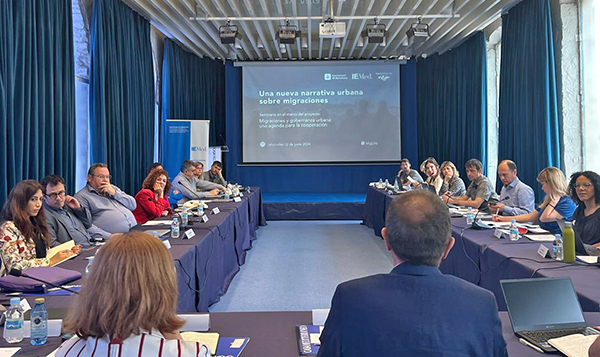
Around thirty experts, journalists and representatives of city networks took part in this seminar to discuss public narratives on migration in urban contexts. The event was co-organised by Casa Mediterráneo within the framework of the project Migration and Urban Governance: An Agenda for Cooperation (MigUrb), led by the Barcelona City Council and IEMed.
The event facilitated the exchange of experiences at the local and media levels, helped identify shared challenges, and explored ways to build narratives that reflect the complex realities of migration and its role in contemporary societies.
More information on the main areas of discussion.
12 June 2024
Casa Mediterráneo (Alacant)
Migration Governance Capacities of Mediterranean Cities: A Strategic Agenda for the Next Decade
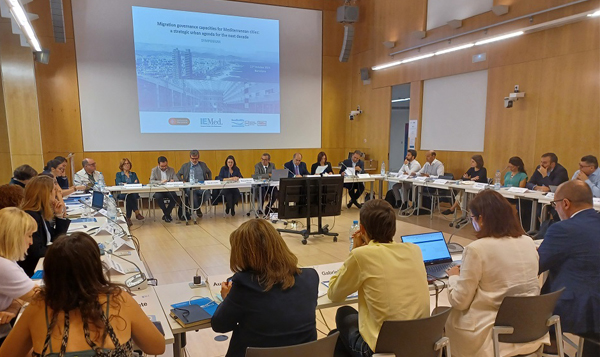
This symposium was held at Pompeu Fabra University and organised in collaboration with the EuroMedMig network of academic migration experts (GRITM-UPF). It brought together 35 participants, including researchers, experts, local public decision-makers from Marseille, Tangier and Istanbul, as well as representatives of regional organisations and city networks, who discussed how to strengthen the capacities and role of Mediterranean cities in migration governance.
The symposium was structured around a series of thematic roundtables addressing a wide range of key issues and challenges in urban migration governance. These included innovation in public policies and urban resilience as tools to overcome the constraints faced by municipalities, the decisive role of organisations supporting cities, the potential of city networks and urban diplomacy to enhance municipal leadership, and the challenges and opportunities related to the generation and interpretation of data at the local level in order to ensure empirically evidence-based policies.
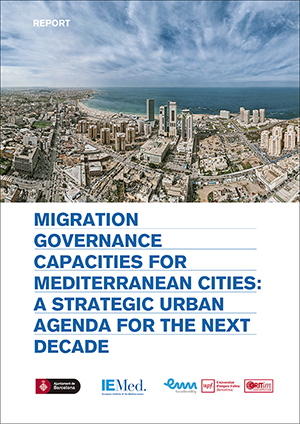
As an outcome of the symposium, a results report was published. Following the thematic structure of the symposium, the report brings together the main elements for a diagnosis of the current situation, as well as ideas and proposals that emerged from the discussions among participants and can be considered key conclusions and building blocks for future resilience strategies. It also includes examples of best practices implemented to date, as well as international initiatives developed by city networks and urban alliances. In addition, the report incorporates a toolbox containing a set of useful data sources and statistical tools related to urban management, planning and local migration.
23 October 2024
Ciutadella Campus, Pompeu Fabra University, Barcelona