



A conversation between Maryam Touzani and Isona Passola
In the incomparable setting of the Ateneu Barcelonès, Isona Passola and Maryam Touzani engage in a conversation about identity, belonging, feminism and migration. Two cinematic perspectives exploring the invisible bonds between both shores of the Mediterranean
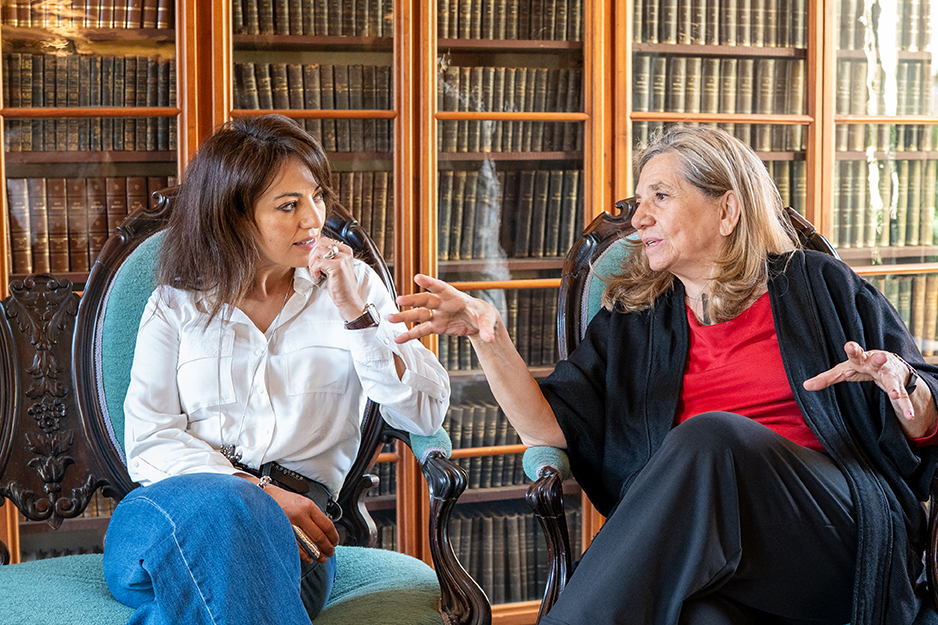
It is a sunny day in Barcelona and the Ateneu Barcelonès, in the heart of the Gothic Quarter, is preparing to host the meeting between two Mediterranean filmmakers. Isona Passola (Barcelona, 1953), president of the institution and of the Association of Independent Mediterranean Producers (APIMED), as well as a key figure in Catalan cinema; and Maryam Touzani (Tangier, 1980), Moroccan director and one of the most acclaimed voices in the cinema of the neighbouring country, who visits the city to present her latest film, Calle Málaga (2025), starring Carmen Maura — another essential woman of our cinema and a truly immense actress.
This encounter is part of the programme of the project Morroco: a contemporary map promoted by the European Institute of the Mediterranean (IEMed) and the Centre de Cultura Contemporània de Barcelona (CCCB). Over the coming months, the programme will travel through four Moroccan cities and territories in order to better understand the social, urban and cultural transformations shaping contemporary Morocco.
Through debates, encounters and diverse voices, the project proposes an approach to present-day Morocco that invites us to rethink the historical, cultural and human ties connecting both shores of the Mediterranean. The first stop is Tangier — Maryam Touzani’s hometown and also the Moroccan city where Calle Málaga belongs to.
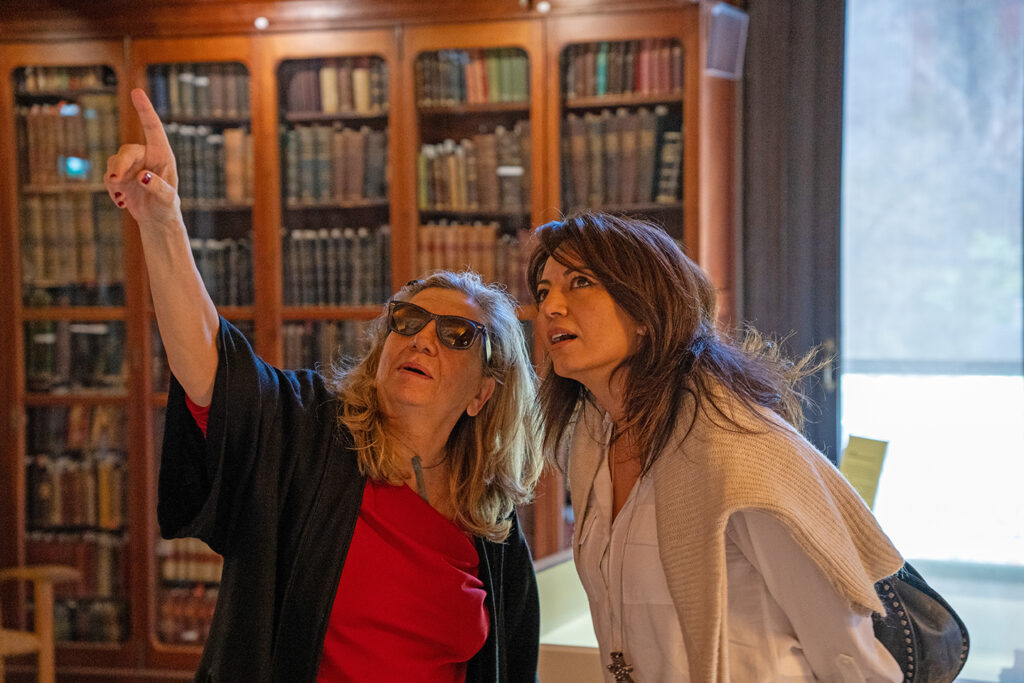
Before the conversation begins, there is still time for an espresso in the romantic gardens of the Ateneu, a true oasis in the historic heart of the Catalan capital. They stroll together among lemon trees, loquats and spider plants. They speak with ease and complicity while Isona, acting as the perfect host, shows her guest some of the best-kept treasures of the Palau Savassona. The library is one of them. In silence, Touzani pauses to admire the coffered ceilings and modernist paintings, letting herself be carried away by the suspended atmosphere and history of the place.
Shortly before sitting down on emerald-upholstered chairs to speak about cinema, migration, identity and everything that both separates and connects the two shores of the Mediterranean, Isona points, from one of the windows of the Pompeu Fabra room, to the house where she was born. From the very beginning, she introduces a theme that will accompany the calm dialogue about to unfold: belonging, rootedness.
They sit down. Isona gently touches with her right hand a long green pendant resting across her chest. Speaking softly, she explains: “It is made of posidonia, the sea grass of the Mediterranean.”
“It is what unites us,” she adds. Beneath the sea, the meadows of Posidonia oceanica connect one shore to another through a unique biodiversity belonging only to this shared sea.
Isona and Maryam represent two generations of filmmakers, two ways of understanding cinema from opposite shores that are perhaps not so far apart after all. They themselves could be mother and daughter, and perhaps that is why their conversation, in French, begins with the relationship between Mari Ángeles and Clara in Calle Málaga. A relationship that is cold, distant, “so selfish”, as Isona points out while trying to decipher the silences between the two protagonists.
Maryam Touzani wrote the screenplay after the death of her mother, to whom she was deeply attached. She felt the need to return to her memories, to the sound of Spanish — the language in which they communicated — and also to the colours, smells and textures of the sensory memory of her native Tangier. They speak about the motivations behind the characters’ decisions and about that profoundly human difficulty of truly understanding one another.
They also speak about belonging to a place. Mari Ángeles clinging to the walls and memories of her home; Isona deeply rooted in Barcelona’s Gothic Quarter; Maryam shaped by the dual Spanish-Moroccan culture of her childhood in Tangier. “This is also a film about memory; Tangier is my mother. Writing this screenplay helped me return to my city in her absence and confront my grief,” Touzani explains.
The city of Tangier awakens memories not only in Maryam, but also in Isona. In 2007, she chaired the jury of the Festival National du Film du Maroc (FNF), organised by the Moroccan Cinematographic Centre, and she recalls “the two faces of the moon” embodied in migration: those who leave and those who stay behind, in a country accustomed to distance and longing. A theme deeply present in Moroccan cinema that can also be felt in the cobblestones of Calle Málaga.
Like the posidonia meadows beneath the sea, the conversation sways gently through different currents, leading both filmmakers towards their own creative processes. “For me, reading and writing are necessities, like breathing,” says Maryam Touzani, who began her professional career as a journalist. “It is a natural, visceral process that allows me to express what I carry inside through my films.” Isona takes the opportunity to recommend Mother of Milk and Honey (Destino, 2018) by Najat El Hachmi. “It’s important that you read her,” she says, speaking of a powerful, “radical” feminist voice. Passola is currently working on the film adaptation of this story of migration between the Rif and Catalonia.
Two women filmmakers who nonetheless slightly disagree on the relationship between women and cinema. Maryam does not believe in quotas or special support measures aimed at increasing female representation in the audiovisual industry. Isona, on the contrary, sees them as temporary mechanisms necessary to achieve real equality. Touzani argues that films “must speak for themselves”, beyond the gender of the person directing them; what matters is talent. For Passola, however, there is still a long way to go: “Patriarchal culture still holds enormous power.” Perhaps that is why she remains the only woman ever to have presided over the Ateneu Barcelonès in its century-long history.
— Maryam Touzani
The cinema I make is, above all, human.
It always contains a social and political
affirmation. That is why I am interested
in characters who live on the margins
Migration, feminism, freedom… their dialogue gradually crystallises around a key question to which, deep down, both share the same answer, albeit in different words: should cinema — and art in general — be political? Is Calle Málaga political?
“The cinema I make is, above all, human. It always contains a clear social and political statement. That is why I am interested in characters who live on the margins, those who have no voice,” says Maryam. Isona picks up the thread from another perspective: “Artistic creation always presents a confrontation between good and evil, justice and injustice. And that confrontation inevitably places us in a political scenario.”
After all, the film tells the seemingly ordinary story of a woman who refuses to give up her ability to choose. At the same time, it speaks of the grand struggle for the most universal of ideals: freedom. Touzani then returns for a moment to Tangier, and specifically to the old Cervantes Theatre. “It will reopen after fifty years closed. Mari Ángeles is like that theatre. Resilience. She reinvents herself, she is reborn.” They speak about resistance. And perhaps there is nothing more political than that.
The conversation then moves towards one of the most delicate territories explored in Calle Málaga: the representation of the body and desire in societies where cultural and moral tensions persist. Isona asks the question almost inevitably, with Carmen Maura’s nude scene still vivid in her mind: “Does censorship not exist in Morocco?”
Maryam smiles softly before answering. “Morocco is a rich and diverse country. Cinema is a voluntary act; audiences choose whether to confront images that challenge or unsettle them.” She explains that the scene was received naturally and that the same sense of modesty often associated with the Maghreb also appeared in European countries. “I wanted to show old age in all its beauty; the freedom to choose how to grow old; the possibility of experiencing sensuality and sexuality at any age. Growing old as a privilege,” Touzani explains. At the age of 80, Carmen Maura embodies that freedom through the first nude scene of her entire cinematic career.
— Isona Passola
The Mediterranean is a dream. It gave birth
to some of the world’s most fascinating
cultures, yet today it is also a space of conflict
Lunchtime approaches. Before saying goodbye, they continue speaking about multiple identities and the diversity contained within this shared sea above an endless garden of posidonia. “The Mediterranean is a dream,” says Passola. “It gave birth to some of the world’s most fascinating cultures, but today it is also a space of conflict.”
Maryam listens and nods. “The key is the human bond, in all its complexity and richness. Humanity lies at the heart of all my films… and perhaps it is also what can still save us,” concludes the Moroccan filmmaker.
The chairs in the Pompeu Fabra room, now empty, no longer seem emerald green but rather carry the aquatic, greenish hue of the posidonia. Isona and Maryam say goodbye warmly; the next commitment in an intense day quietly awaits them in their schedules. The Ateneu slowly recovers its silence while the midday sun shines above, illuminating the geometric flowerbeds of the mezzanine garden — silent witnesses to the encounter between two women filmmakers.