
The UFM vision statement 2025: a defensive turn in Euro-Mediterranean regionalism
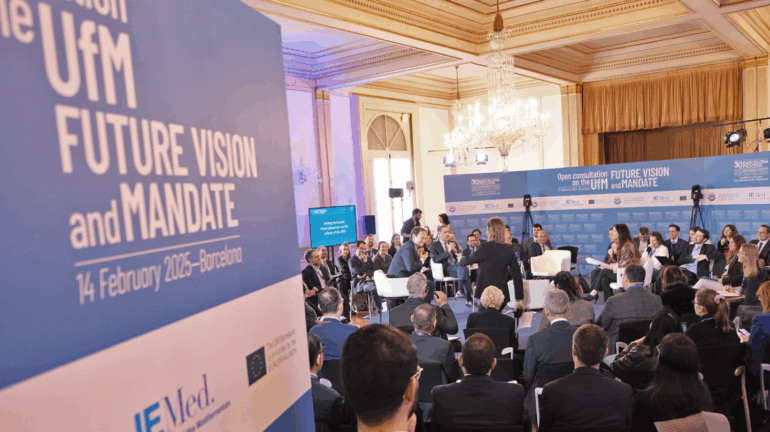
The adoption of the Vision Statement 2025: Reconnecting the Mediterranean. Back to the Core, Forward with Ambition by the Union for the Mediterranean (UfM) Foreign Ministers at the 10th Regional Forum in Barcelona on 28 November 2025 marked the culmination of a formal process of strategic reflection initiated by the UfM in 2023. This process unfolded at one of the most critical junctures for Euro-Mediterranean regionalism since the launch of the Barcelona Process in 1995. Prolonged armed conflicts, increasing geopolitical fragmentation, weakening of multilateralism, an aggravated climate crisis, and persistent socioeconomic tensions have eroded the capacity of regional frameworks to foster effective cooperation that leads to stability and tangible benefits for both shores of the Mediterranean.
In this context, the UfM Vision Statement seeks to provide the UfM with a renewed orientation and mandate clarification, while bolstering its political and operational impact. Against this background, as is often the case in consensus-based intergovernmental organisations, the approved text reflects a carefully negotiated balance among divergent national positions, asymmetric expectations between the UfM northern and southern member states, and structural disagreements over the appropriate degree of politicisation for the organisation.
Since its establishment in 2008, the UfM has operated in a fragile equilibrium of rhetorical ambition earmarked by a very limited annual budget of 8.6 million EUR, technocratic pragmatism, and institutional survival. Unlike previous times in Euro-Mediterranean regionalism, the UfM Vision Statement does not stem from a moment of conjunctural optimism or from an expansion of normative horizons, but rather from a defensive logic. The implicit goal of such a document is not necessarily to relaunch a transformative project comparable to the Barcelona Process of 1995, but to preserve the political and functional relevance of the UfM as the only inclusive regional framework in a context increasingly dominated by bilateral dynamics, securitised approaches, and fragmented responses to specific multiple crises.
This article aims to critically analyse the UfM Vision Statement 2025 through a comparison with internal preparatory documents − including non-papers and other written contributions by UfM member states − released during the discussions on the reform process. The article assesses the extent to which the adopted document responds to the structural crisis of Euro-Mediterranean regionalism, while identifying the concrete progress it introduces, and highlighting the ambitions that have been reformulated, diluted, or excluded from the final consensus.
Visit the EuroMesCo website to download the EuroMeSCo Spot-On.
EuroMeSCo’s Academic Secretariat is managed by

With the support of