


A New Urban Narrative on Migrations
12 June 2024 | News
The headquarters of Casa Mediterráneo hosted the seminar “A new urban narrative on migrations” the first activity of the project “Migration and Urban Governance: An Agenda for Cooperation (MigUrb)” promoted by IEMed and Barcelona City Council. A project that aims to provide tools and contents for positioning cities as central actors for establishing migration governance strategies at urban level, and making them effective, inclusive and cooperative.
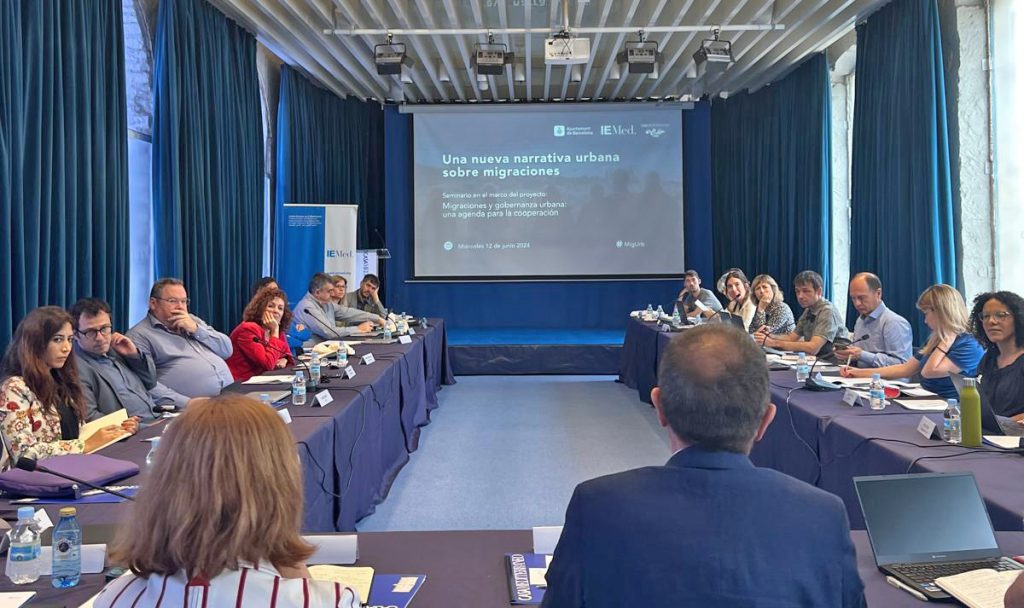
The seminar brought together 28 participants, including experts, journalists, representatives of city networks, and professionals and addressed the need for a paradigm shift in current public narratives. During the scheduled sessions, participants shared experiences from both the local and media spheres and identified common challenges that migration policies must tackle in order to influence public opinion and help build inclusive messages that serve citizens.
The main contributions can be grouped into three key thematic areas.
First, the current context — shaped by the impact of the EU’s new Pact on Migration and, significantly, the results of the European Parliament elections — and how these developments influence migration narratives and may determine the implementation of the migration agenda.
The second theme focused on cities and local narratives, while the third centred on proposals for the narratives that need to be constructed.
Key Findings
Context
Cities are conceived as open structures in contrast with a European Union that is increasingly closed. Therefore, there is a need to develop a positive interpretive framework and identify narrative elements that can help shape it.
The current moment is highly complex and requires strong political leadership, with discourse at the forefront. This means promoting public narratives as a foundation for public policy and encouraging cooperation with other cities.
A deep analysis is needed of the social, economic, and cultural factors that have led to the shift from open policy models to more restrictive ones.
City and Local Narrative
It is essential to distinguish between state-level discourses and everyday needs, especially at the local level, where inclusion and social protection are key to creating a genuine sense of “we”.
Cities face the challenge of communicating inclusive policies that go beyond silence or empty slogans, while managing the tension between narrative and lived reality.
Electoral processes require cities to skilfully manage internal diversity. Although cities may not have full competences, they are nonetheless expected to act responsibly.
Migration narratives must be linked to concrete actions (training, data, inter-city cooperation networks) and include the active participation of migrants in shaping interpretive frameworks and local policies.
Narratives to Be Constructed
There is a shift underway from narratives of solidarity to those of hostility and fear. These negative narratives — which associate migration with economic or security threats — have contributed to restrictive policies and the perception of a permanent migration crisis.
Shared imaginaries at the local level, co-produced by various social actors, shape migration narratives. These narratives can be used to amplify fear, but also to promote more inclusive and progressive visions.
Public discourse and narratives influence policy-making. There is a clear need to center positive, value-based narratives (inclusion, human rights, solidarity) as the foundation for transforming urban policies.
Cities should be conceived as inclusive spaces where the rights of all residents — including migrants — are respected, be they material, symbolic, or political. This requires transforming dominant narratives to highlight coexistence, diversity, and inclusion.
The media and political discourse play a crucial role in shaping narratives. Too often, these narratives generate negative and stereotypical images of migrants, reinforcing a “us” vs. “them” mentality. A shift is needed toward more humanising, evidence-based messages.