



China sees the Balkan region as an indispensable corridor on its China-Europe Land-Sea Express Line, which runs from the port of Piraeus in Greece to Budapest in Hungary. The region had a pivotal role in China’s connectivity ambitions in the framework of the Belt and Road Initiative (BRI), as well as in the cooperation platform between China and central and eastern Europe (CEE) (initially known as the 16+1 initiative). A number of strategic investments and loan-funded projects have helped to anchor China’s presence in the region, facilitating the flow of Chinese imports to Europe and creating business opportunities for Chinese banks and companies. More recently, however, Chinese initiatives in most of the Balkan countries have been running out of steam. This article aims to examine the reasons thereof, the impact of China’s presence thus far, especially on the economies of the non-EU countries in the region, and the prospects for future cooperation.
Being in or out of the EU Does Matter
Ten years ago, when China started to enhance its global presence through the BRI and engaged most of the central, northeast and southeast European countries in the China-CEE cooperation platform, it sought to rationalize the resources and maximize the impact by grouping small and mid-sized countries under one “umbrella” for regional cooperation. Aware that China’s attractiveness lies first and foremost in the size of its market and capital flows, Chinese policymakers devised a cooperation offer based mostly on the prospects for increased trade, tourism, investments and funding for infrastructure projects. While at the beginning of the cooperation the European partners were very interested in engaging with China, over time the outcome in different countries became unequal, their enthusiasm started to wane and many of them became disenchanted. Moreover, a division – although not a very strict one – became visible along the line of EU membership, when it came to how European countries approached cooperation with China and what benefits they sought to gain.
The EU accession countries in the Balkans (also known as the Western Balkans) do not have access to the EU’s structural funds, but to funding instruments which provide them with approximately five times less EU assistance compared to EU members. Hence, for all of them – Albania, Bosnia and Herzegovina, Montenegro, North Macedonia and Serbia,[1] securing favourable loans for large infrastructure projects from Chinese banks became paramount and, with the exception of Albania, they were the only countries to use funds from the US$ 10bn credit line made available in the China-CEE cooperation platform. Furthermore, while all candidate countries have the obligation to align with EU legislation in the course of their EU accession process, such obligation is not enforceable until full EU membership. This leaves authorities in the Western Balkans with more “room for manoeuvre” to accommodate cooperation with China and even bend their national rules as they see fit.
Formulation of the contractual relationship,
alongside the high loan amounts in comparison
to the size of the recipient countries’ budgets,
puts the Western Balkan countries
in a vulnerable and highly dependent position
vis-à-vis China
In that context, Serbia, Bosnia and Herzegovina, Montenegro and North Macedonia decided to “privilege” Chinese companies by awarding them big contracts for transport and energy projects without public procurement procedures, often concluded in “four-eyes” and classified as confidential. Some of the projects, such as the highway construction in Montenegro and North Macedonia, have been marred with implementation controversies, overruns and allegations of corruption. Moreover, the loan contract provisions in most cases are highly asymmetrical, as the applicable legislation is Chinese law, arbitration is set in Beijing and China has leeway to terminate the contracts in case of policy or political change (Krstinovska, 2022). Such a formulation of the contractual relationship, alongside the high loan amounts in comparison to the size of the recipient countries’ budgets, puts the Western Balkan countries in a vulnerable and highly dependent position vis-à-vis China.
Trade and Investments – the Core of the Cooperation
The uptick in cooperation with China in the past decade has led to a surge in the bilateral exchange in goods. All Western Balkan countries increased their imports of Chinese goods, in some cases, such as Serbia, tripling the value in the period 2011-2021. The composition of the imported goods reflects, on the one hand, the shift in the Chinese economy towards the production of higher-value goods, such as machinery and electronics, and, on the other, the lower purchasing power of the Western Balkan sub-region which is Europe’s poorest. In that context, the imports of Chinese goods are largely seen as beneficial for consumers in their efforts to secure better quality of life, as well as for local companies which depend on Chinese inputs to be competitive.
CHART 1 China-Western Balkans Trade (2011-2021)
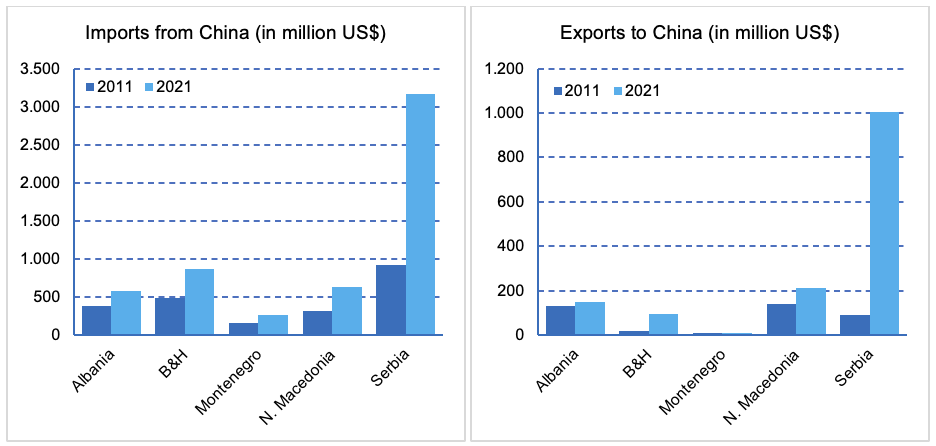
Most of the countries also increased the value of exports to China, with Serbia topping the list and exporting ten times more in 2021 compared to 2011. While increased exports certainly provide a boost to the local economies, the structure of the exported goods presents a rather gloomy picture. With the exception of Bosnia and Herzegovina, all the countries predominantly export extractive goods, that is mining products and raw materials, the exploitation of which depletes natural resources, leads to pollution and environmental degradation and does not provide high revenues to the local economies (Krstinovska & Vuksanovic, 2023). In some years, extractives have accounted for 90% of the total exports to China, which was not the coveted outcome for Balkan policymakers seeking to export predominantly agricultural products and products with higher value-added.
It is the outcome, however, of China’s broader strategic thinking and its interests in the Western Balkan region. Namely, through its investments China has penetrated crucial industries which enable it either to strengthen its global dominance or to satiate its thirst for raw materials, especially those of critical importance. In Albania, in 2010 the Sino-Turkish consortium composed of Sichuan Jiannanchun and Kurum invested in chromium mines; in 2014 Jiangxi Copper acquired 50% of the shares in the country’s largest copper mines; in 2016, GeoJade bought Bankers Petroleum, the largest on-shore oil exploration in continental Europe. In North Macedonia, Hesteel owns 50% of the biggest steel mill, Makstil, as it acquired ownership of its mother company, the Swiss-Luxembourgish Duferco Holding. In Serbia, in 2016, Hesteel acquired the Smederevo Steel mill and in 2018 Zijin Mining started to invest in the copper and gold mines near the city of Bor.
Serbia, over the years
has become China’s preferential partner,
investment destination and
strategic hub in the region
With the exception of Serbia, the other countries in the region cannot boast significant Chinese capital in other areas, especially when it comes to greenfield investments. Serbia, however, over the years has become China’s preferential partner, investment destination and strategic hub in the region, with a total stock in 2022 equal in value to the combined investments of the 27 EU Member States (Vladisavljev, 2023). This is the result of multiple factors, namely the size and strength of the Serbian economy, its traditional friendship with China dating back to Yugoslav times and particularly the war in Kosovo, as well as the China-friendly policies of the current Serbian leadership.
The Impact of (Geo-)politics
President Vucic’s willingness to go an extra mile to accommodate Chinese interests has been visible through the public support and subsidies provided to Chinese investors in the country. The case of the Linglong tyre factory in Zrenjanin is one of the most prominent examples often put forward by civil society analysts who claim that the state aid granted to the company, as well as its construction permit. was illegal (Zivkov, 2022). Activists have also long mobilized around the Chinese investments in Smederevo and Bor, as they have led to severe environmental degradation and public health issues (Petkova, 2021). More importantly, they reproach the government institutions, inspection services and the judiciary for failing to consider citizens’ concerns and take appropriate action in order not to displease Chinese investors and authorities (Bjelos & Vuksanovic, 2022).
In addition to the mere economic logic of attracting Chinese investors, Serbian authorities have a transactional, political calculus. Their support for China in international fora, such as the UN, as well as the upward trend in bilateral cooperation amidst the current global polarization have secured them a privileged status with the Chinese authorities, who are, in turn, also ready to accommodate Serbian needs. Besides prioritizing Serbia on the investment map and providing it with funding for infrastructure development, China is providing legitimacy and supporting the agenda of the current Serbian leadership, especially on the Kosovo issue. Namely, since the war in Ukraine in 2022 and with Russia losing some of its diplomatic capital, China has become Serbia’s staunchest supporter in its efforts to contain Kosovo’s international recognition and membership in international organizations (Krstinovska & Demjaha, 2022).
Unlike Serbia, other countries in the region have become less welcome to China’s economic presence. The division seems to follow the line of NATO membership, with Albania, Montenegro and North Macedonia not signing up for any major deals with China in the past few years. Albania and North Macedonia are also signatories of the US-led Clean Network Initiative which aims to exclude non-secure vendors from the 5G telecommunications infrastructure, implicitly targeting Chinese companies. Albania has even seen cases of disinvestment by Chinese companies, the most prominent one being Everbright, which sold its concession of Tirana International Airport to a local company in 2020, as Albania started to further strengthen its strategic ties with the USA.
Conclusion
In recent years, only Serbia and, in part, Bosnia and Herzegovina (particularly the Republika Srpska entity) – countries with largely complex internal political situations and/or complicated relationship with NATO and “the West” – have decided to pursue closer relations with China in strategic areas. The reasons behind the decline in the intensity of cooperation for the other Western Balkan countries are manifold. Most of them have become disenchanted, their expectations regarding economic engagement when it comes to exports and attracting foreign direct investments unfulfilled in terms of both quantity and quality. The infrastructure projects funded through Chinese loans were wrought with controversies and irregularities, which also served as a deterrent. In such a context, with geopolitical pressure piling up for the region to take a side and align with EU and US positions on China, most of the Western Balkan countries naturally opted for “the West.” That is not to say that these countries are likely to stop cooperating with China in the future or to compromise their bilateral relationship. But, they are certainly likely to refrain from developing more strategic ties and limit themselves to symbolic cooperation only.
References
Krstinovska, Ana. “China’s Development Assistance to the Western Balkans and its Impact on Democratic Governance and Decision-Making.” in Journal of Liberty and International Affairs, vol.8, N.1, 2022, p.273, https://e-jlia.com/index.php/jlia/article/view/485/279
Krstinovska, Ana and Vuksanovic, Vuk. “Win Some, Lose Some”: China’s Involvement in the Extractive and Raw Materials Industries in the Western Balkans, Prague: China Observers in Central and Eastern Europe (CHOICE), Association for International Relations (AMO), June 2023, https://chinaobservers.eu/wp-content/uploads/2023/06/win-some-loose-some_policy-paper_A4_09_web-1.pdf.
Petkova, Mirela. The Environmental Impact of Chinese Projects in the Western Balkans. Prague: China Observers in Central and Eastern Europe (CHOICE), Association for International Relations (AMO), September 2021, https://chinaobservers.eu/the-environmental-impact-of-chinese-projects-in-the-western-balkans/.
Vladisavljev, Stefan. How Did China Become the Largest Investor in Serbia? Prague: China Observers in Central and Eastern Europe (CHOICE), Association for International Relations (AMO), 2023, https://chinaobservers.eu/how-did-china-become-the-largest-investor-in-serbia/.
Zivkov, Ivan. Piercing the Chinese Wall in Zrenjanin – Civic Activism VS. Linglong. Belgrade: Belgrade Centre for Security Policy (BCSP), June 2022, https://bezbednost.org/wp-content/uploads/2022/06/Piercing-the-Chinese-Wall-in-Zrenjanin-%E2%80%93-Civic-Activism-VS.-Linglong.pdf.
Bjelos, Maja and Vuksanovic, Vuk. Geopolitics is Local: Ramifications of Chinese Projects for Human Security in Serbia. Belgrade: Belgrade Centre for Security Policy (BCSP), June 2022, https://bezbednost.org/wp-content/uploads/2022/06/Geopolitics-is-Local-%E2%80%93-Ramifications-of-Chinese-Projects-for-Human-Security-in-Serbia.pdf.
Krstinovska, Ana and Demjaha, Agon. “Will China challenge the US on the Kosovo issue?” in The Diplomat, August 2022. https://thediplomat.com/2022/04/will-china-challenge-the-us-on-the-kosovo-issue/.
[1] Kosovo’s independence is not recognized by China and the two sides do not have official relations, hence Kosovo will not be examined in this paper.