
Women, Culture, and the Path Toward Equality
6 March 2026 | News
This year, on the occasion of International Women’s Day 2026, we aim to foreground the reflections of women working in the cultural field and connect their voices to the concrete activities carried out within our culture programme in 2025.
Through this initiative, we reaffirm our commitment to defending women’s rights, celebrating their strength, and recognising the creativity and intellectual power that shape our communities every day.
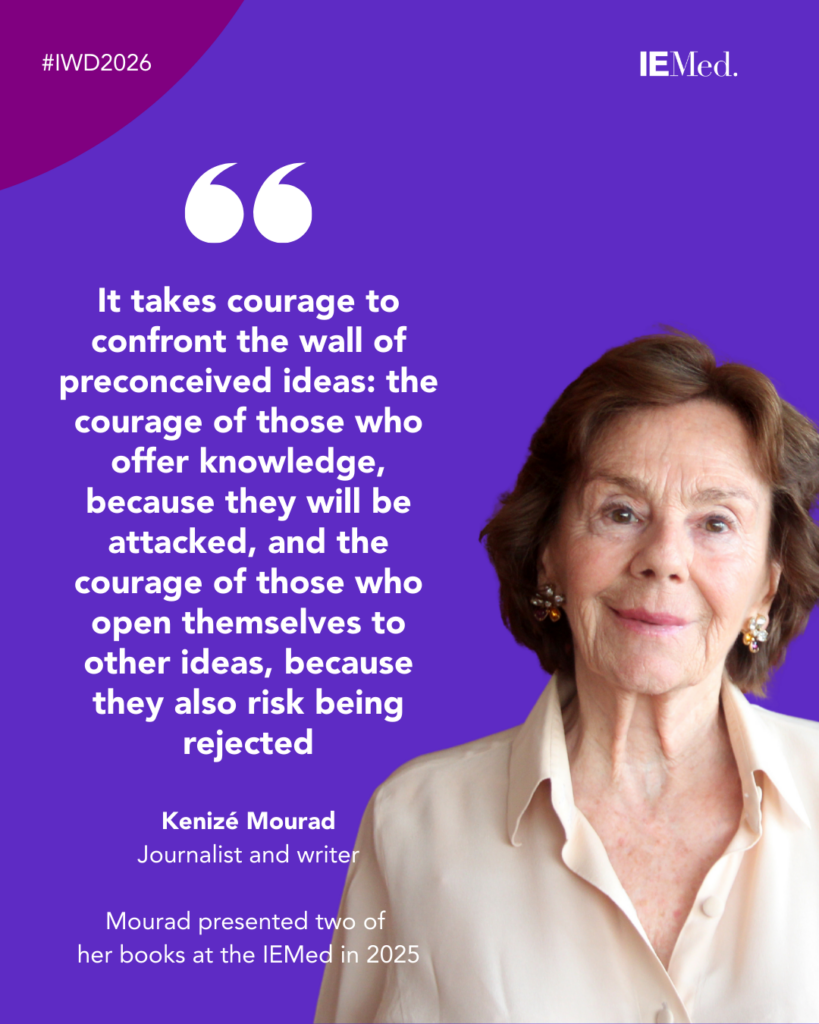
Kenizé Mourad
Culture—not the kind that shines, but the kind that allows us to understand the world—is today essential, indispensable.
In this Mediterranean region, where countries and communities confront one another, each invoking its own truth, violence is increasingly justified—a violence based on ignorance, whether real or feigned.
Whether in the Israeli–Palestinian question or in ecology, much work has been done, but it still has to reach the general public, so that people can think, reason, and choose based on reality, rather than on lies.
But today it takes courage to confront the wall of preconceived ideas: the courage of those who offer knowledge, because they will be attacked, perhaps even threatened; and the courage of those who step out of their intellectual comfort and open themselves to other ideas, because they also risk being rejected by a society that is becoming increasingly conformist and intolerant.
Kenizé Mourad
Journalist and writer
Mourad presented the Spanish edition of two of her books at the IEMed in 2025.
Elizabeth Grech
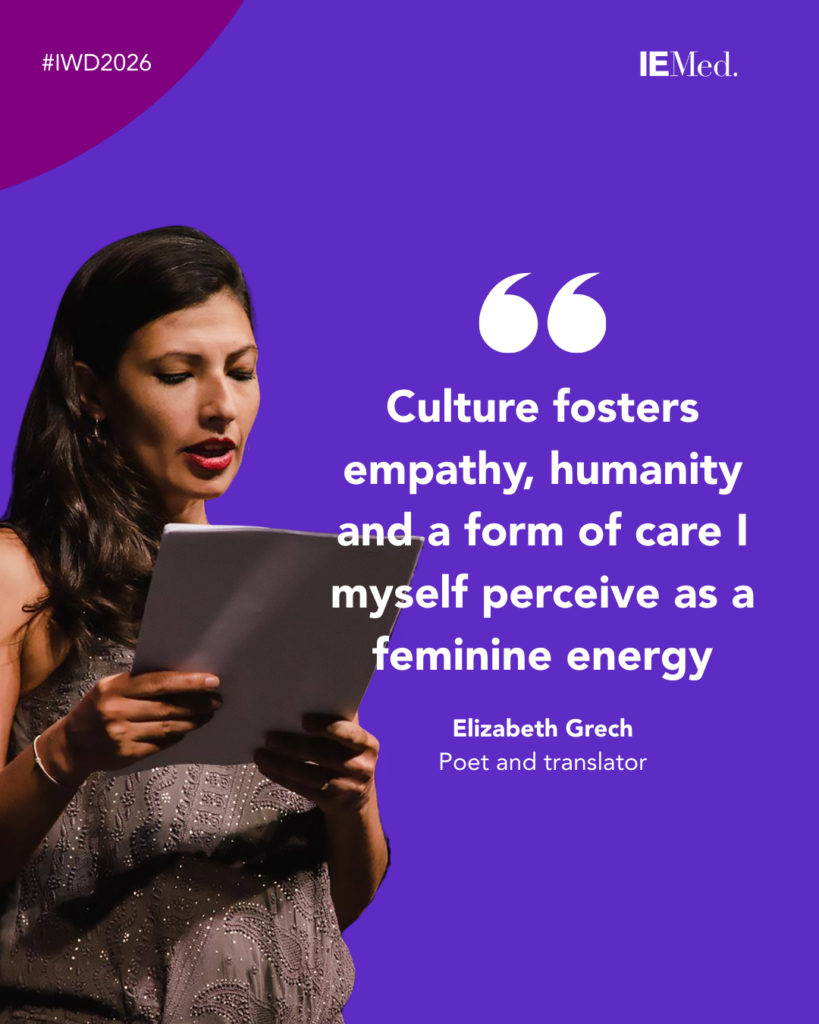
As a woman working in culture and the arts for social innovation, and through my work with Mana Chuma Teatro in recent years — between Malta, France and Reggio Calabria — my Mediterranean experience has been shaped through encounters and shared challenges. As a poet, I see language as a living space where roots and invention meet, allowing differences to resonate rather than divide. Tradition does not enclose us: it nourishes creativity and keeps memory alive. Culture fosters empathy, humanity and a form of care I myself perceive as a feminine energy. The Mediterranean is not a frontier but a horizon we share. Fundamentally political, artistic creativity helps sustain the fragile fabric that binds our communities and gives meaning to our shared future.
Elizabeth Grech
Poet and translator
Communications & International Relations, Mana Chuma Teatro
Contributor to the QM review
Chiara Pumper
I grew up thinking that anger is strength. That tears are the weakness.
Community around me taught me better, in the meantime. I learned. I grew. Many others didn’t.
Adults are just big hurt children in the end, and many of us still don’t like to share our toys – or our feelings. Cause we have to be strong.
But you can only stay strong for so long. And once all those feelings you don’t want spill out, they bury us. What is a war but a playground fight with consequences?
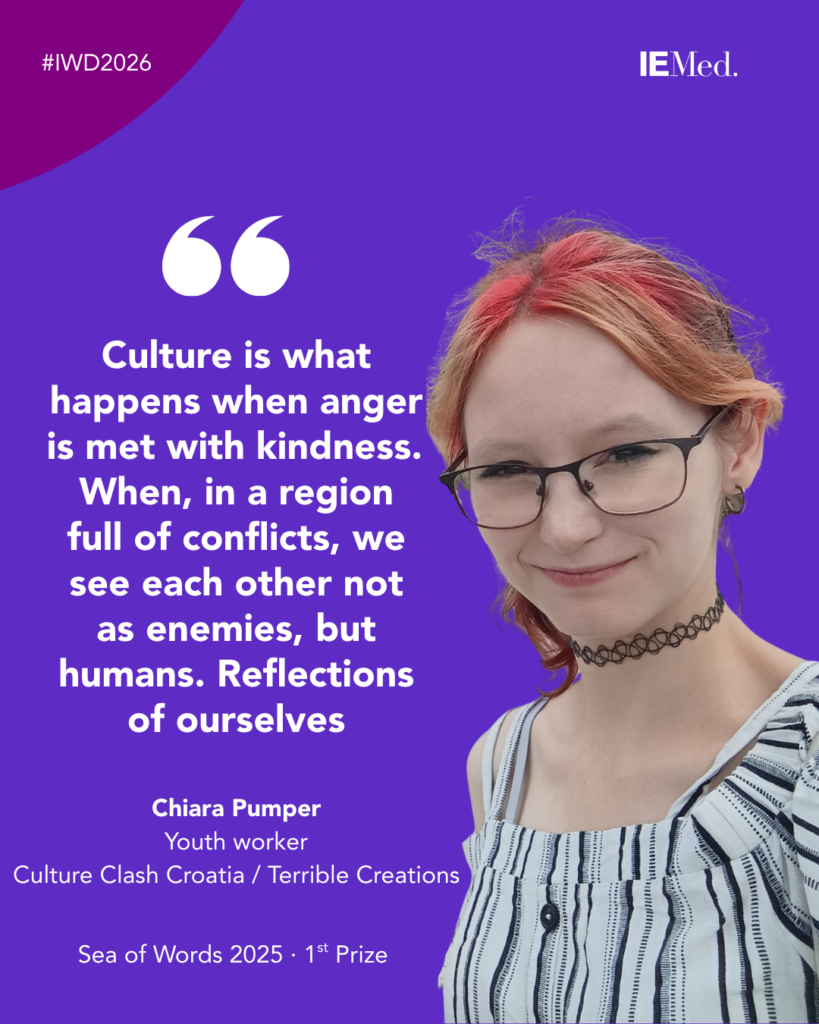
Culture is what happens when that anger is met with kindness. When we recognise each other through the pain. When, in a region full of conflicts, we see each other not as enemies, but humans. Reflections of ourselves.
Sometimes, I learned, we just have to listen. Embrace. Share.
Culture is what connects us, past languages and land.
In the end we all just wanna be seen.
Chiara Pumper
Youth worker
Culture Clash Croatia / Terrible Creations
A Sea of Words 2025 – 1st Prize
Chaymaa Ramzy
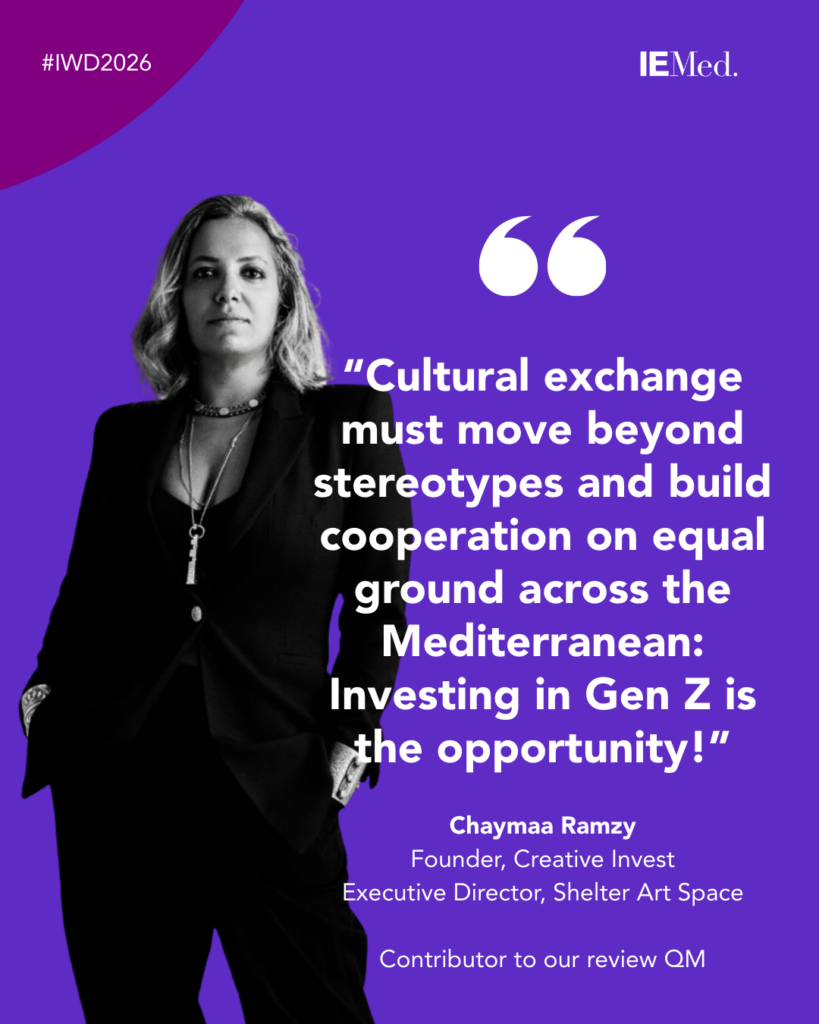
Women’s leadership in the arts proves that competence, vision and impact are not defined by gender. My perspective is not framed by identity but by practice: culture has empowered generations to think critically and act responsibly. I work to create structured spaces where young people—especially Gen Z—can address the realities they face in their local societies. While inclusive in approach, I recognise that young women navigate distinct pressures and still need platforms to speak about their current social pressures within their local communities.
In moments of regional tension, exchange becomes essential. Shared productions, mobility and circulation of exhibitions allow us to see one another beyond stereotypes. Cultural exchange should not reinforce a narrative of a “strong North” and a “fragile South,” but reveal similarities, mutual capacities and the possibility of cooperation on equal ground. Strengthening decentralised ecosystems—from Alexandria to other local south contexts—is how we transform crisis into collaboration.
Chaymaa Ramzy
Founder, Creative Invest
Executive Director, Shelter Art Space (Alexandria)
Member of the QM Review Advisory Board
Nadia Hafid
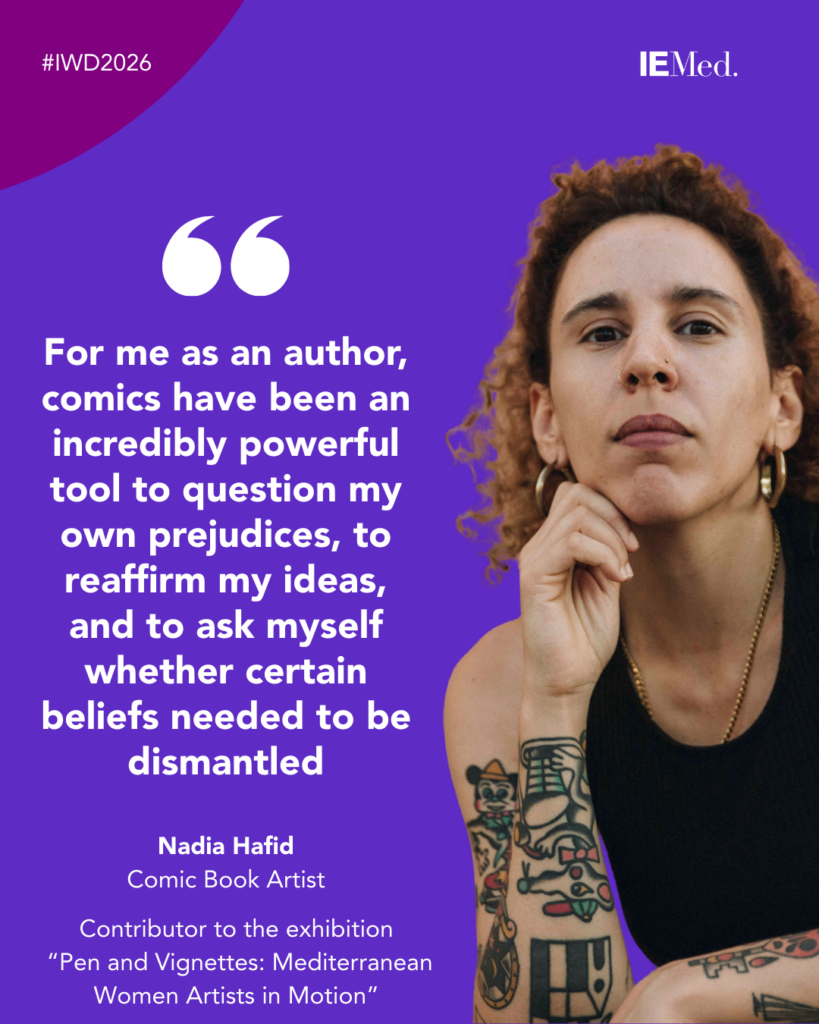
For me as an author, comics have been an incredibly powerful tool to question my own prejudices, to reaffirm my ideas, and to ask myself whether certain beliefs needed to be dismantled. They have given me the opportunity to connect with other people’s perspectives. And that is very powerful.
When you finish reading someone’s work and connect with what they are telling you—their story, their vision, their context… That is precisely the magic of artistic creations.
Art and culture must be accessible and valued as a pillar of a person’s life and education. They help us understand the world we live in, think critically, and question the messages that reach us. Sometimes everything is reduced and labeled, but things are far more complex. It isn’t simple—but that is why culture exists: to make us think.
Nadia Hafid
Comic Book Artist
Contributor to the exhibition “Pen and Vignettes: Mediterranean Women Artists in Motion”
Assoul Massoud
This summer I took refuge in a basement in Sweida, in southern Syria, together with my parents, while violence once again marked our hours. Weeks later I returned to Barcelona with my partner, who risked his life to come find me, and I went back on stage as a soprano and singer with the group ATHRODEEL. That passage between war and music sums up the conviction that runs through my work: culture is not a luxury in times of crisis, but a vital necessity.
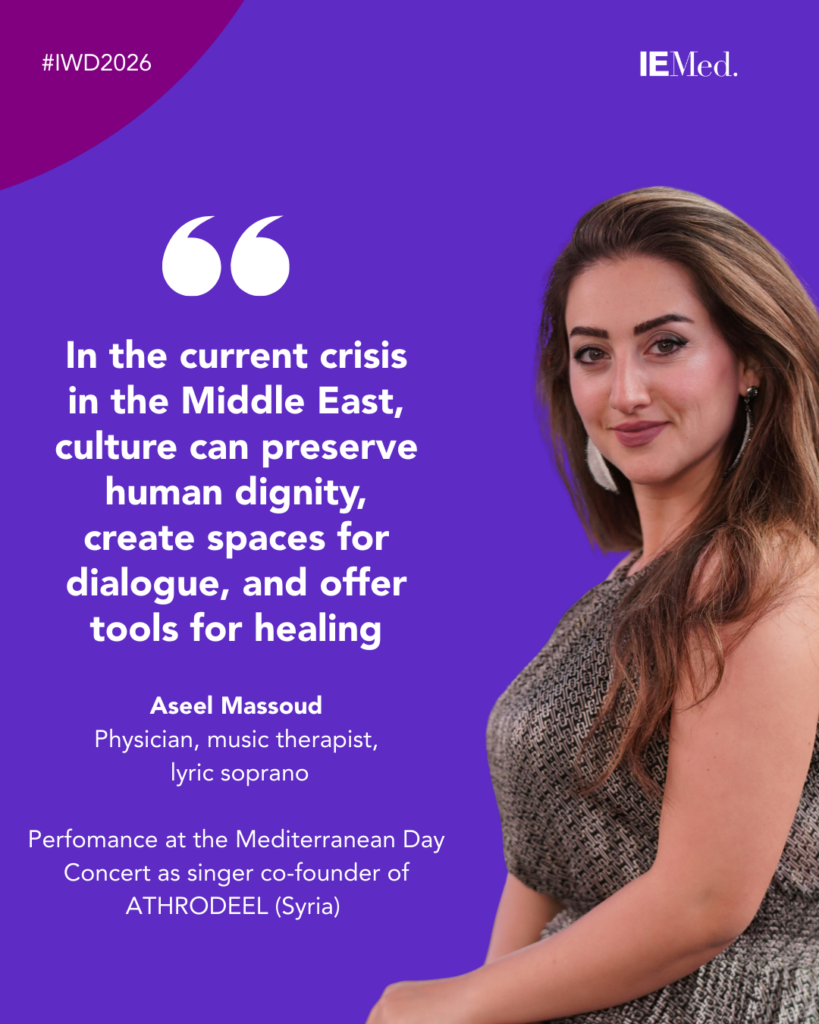
In the current crisis in the Middle East—marked by wars, migrations, and social fractures—culture can preserve human dignity, create spaces for dialogue, and offer tools for healing. As a physician and music therapist, I have seen how trauma is inscribed in the body and how sound can open paths toward repair. As a woman artist, I know that taking the stage is also an act of affirmation and resistance.
Culture does not stop bombs, but it sustains those who survive. It does not replace politics, but it makes it possible to imagine shared futures. In a wounded Mediterranean, creating is also a way of caring, remembering, and rebuilding community.
Aseel Massoud
A physician, a music therapist, a lyric soprano, and singer co-founder of Athrodeel (Syria), a duet that performed at the Mediterranean Day Concert in Barcelona.
Meritxell Bragulat
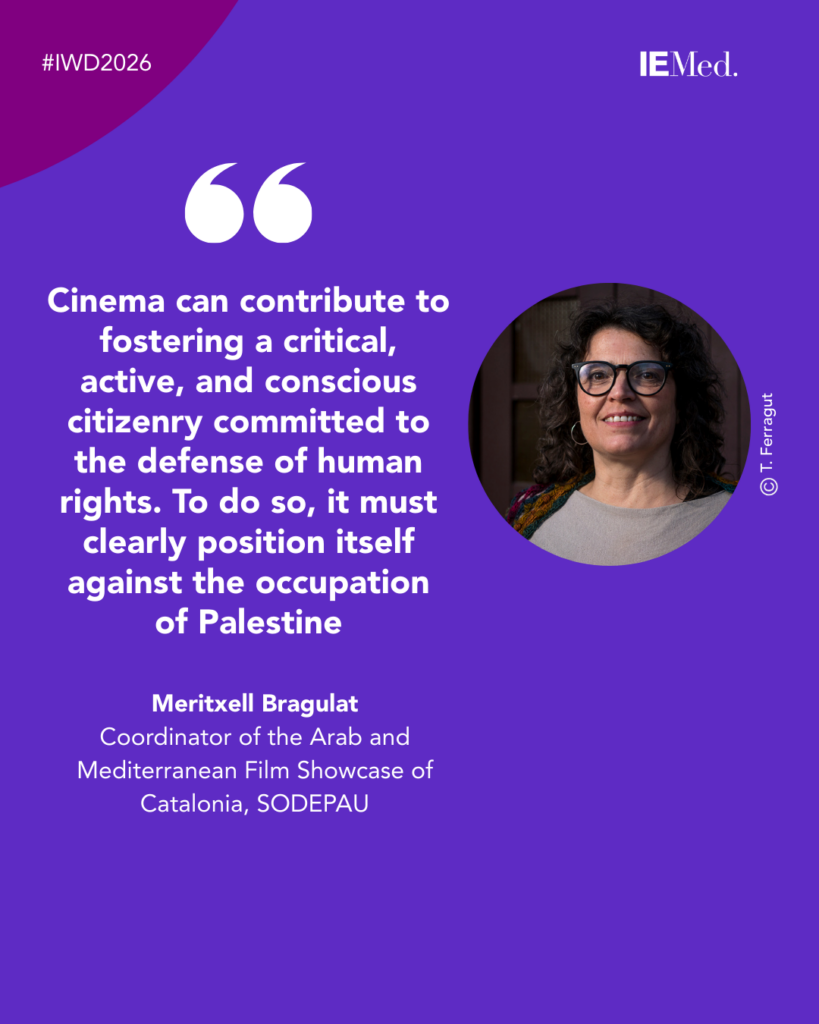
My name is Meritxell Bragulat and for the past twenty years I have been dedicated to promoting the cinemas of North Africa and the Eastern Mediterranean in the Catalan-speaking territories through the organization of the Arab and Mediterranean Film Showcase of Catalonia. After many years of experience and in light of the gravity of what we have been experiencing in the Mediterranean since October 7, 2023, I believe we must question the belief that culture—or cinema in this case—by itself is an element of liberation or transformation of realities. We must remember that it is people, when we act collectively, who give ourselves this capacity to bring about change. Cinema plays an important role in the creation of collective imaginaries, but also in the deconstruction of hegemonic imaginaries. Some works stimulate critical thinking, while others contribute to reinforcing stereotypes and prejudices. The point of view from which works are created or disseminated is crucial, as well as the intention behind them—how they are made, and for whom.
At a time of genocide against the Palestinian people and the expansion of the colonial project in the Mashreq, cinema can contribute to fostering a critical, active, and conscious citizenry committed to the defense of human rights. To do so, it must clearly position itself against the occupation of Palestine.
Meritxell Bragulat
Coordinator of the Arab and Mediterranean Film Showcase of Catalonia, SODEPAU.